One Mosquito, Three Viruses, One Diagnostic Problem
Dengue, chikungunya, and Zika share one vector and nearly identical early symptoms — but require very different responses. Here is what the 2025–2026 data tells us, and why precise differentiation matters more than ever.
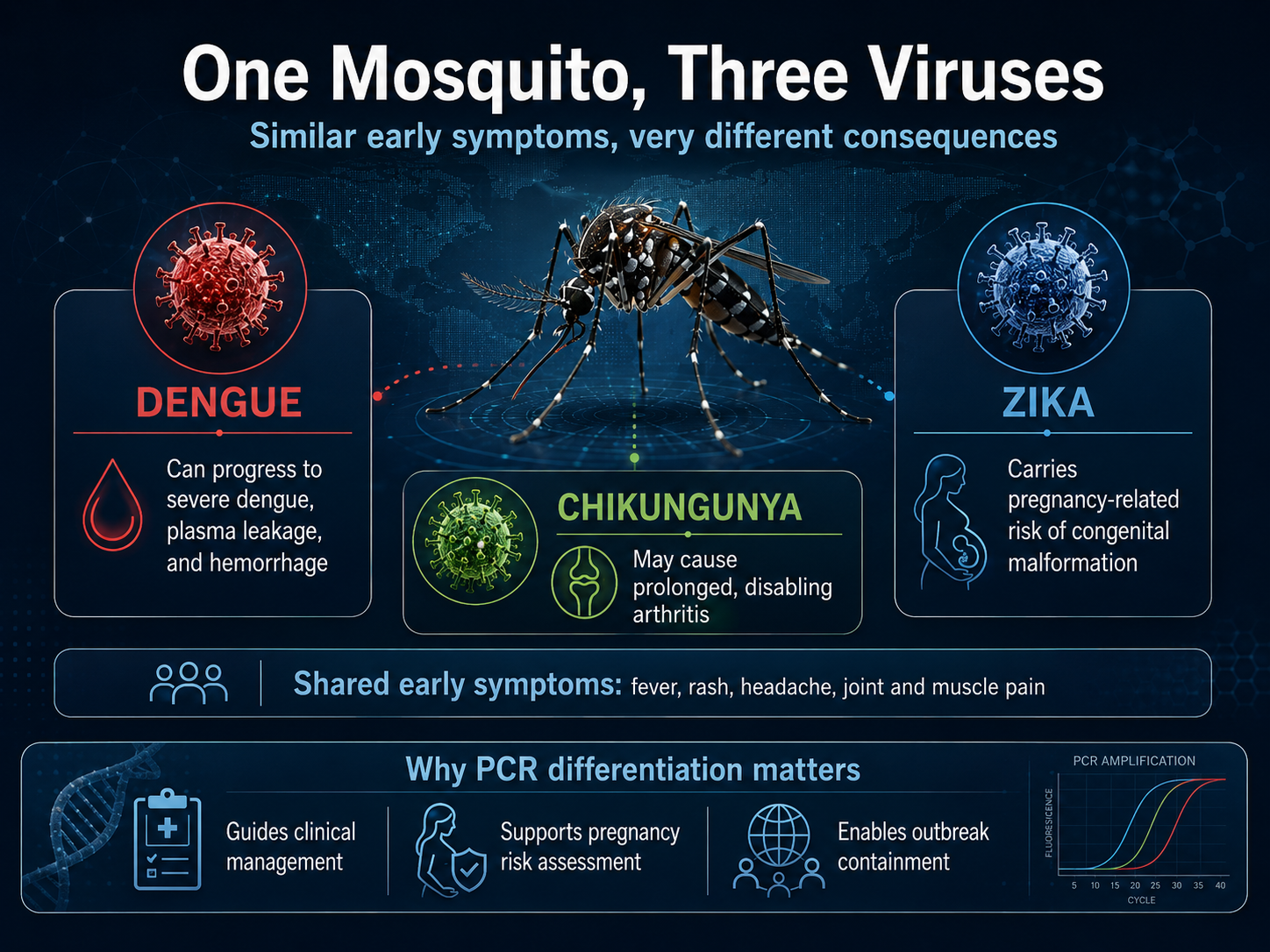
Dengue, chikungunya, and Zika are all transmitted by Aedes mosquitoes — primarily Aedes aegypti and Aedes albopictus. In their early stages, all three present with overlapping, non-specific symptoms, including fever, joint and muscle pain, headache, and rash. For frontline clinicians, telling them apart based on symptoms alone is often impossible.
Yet the distinction is anything but academic. Severe dengue can progress to plasma leakage and hemorrhage; chikungunya can cause prolonged, disabling arthritis; and Zika carries the risk of congenital malformation during pregnancy. The presentation may look similar, but the clinical and public health implications are very different.
Chikungunya: A Global Resurgence Still Gaining Momentum
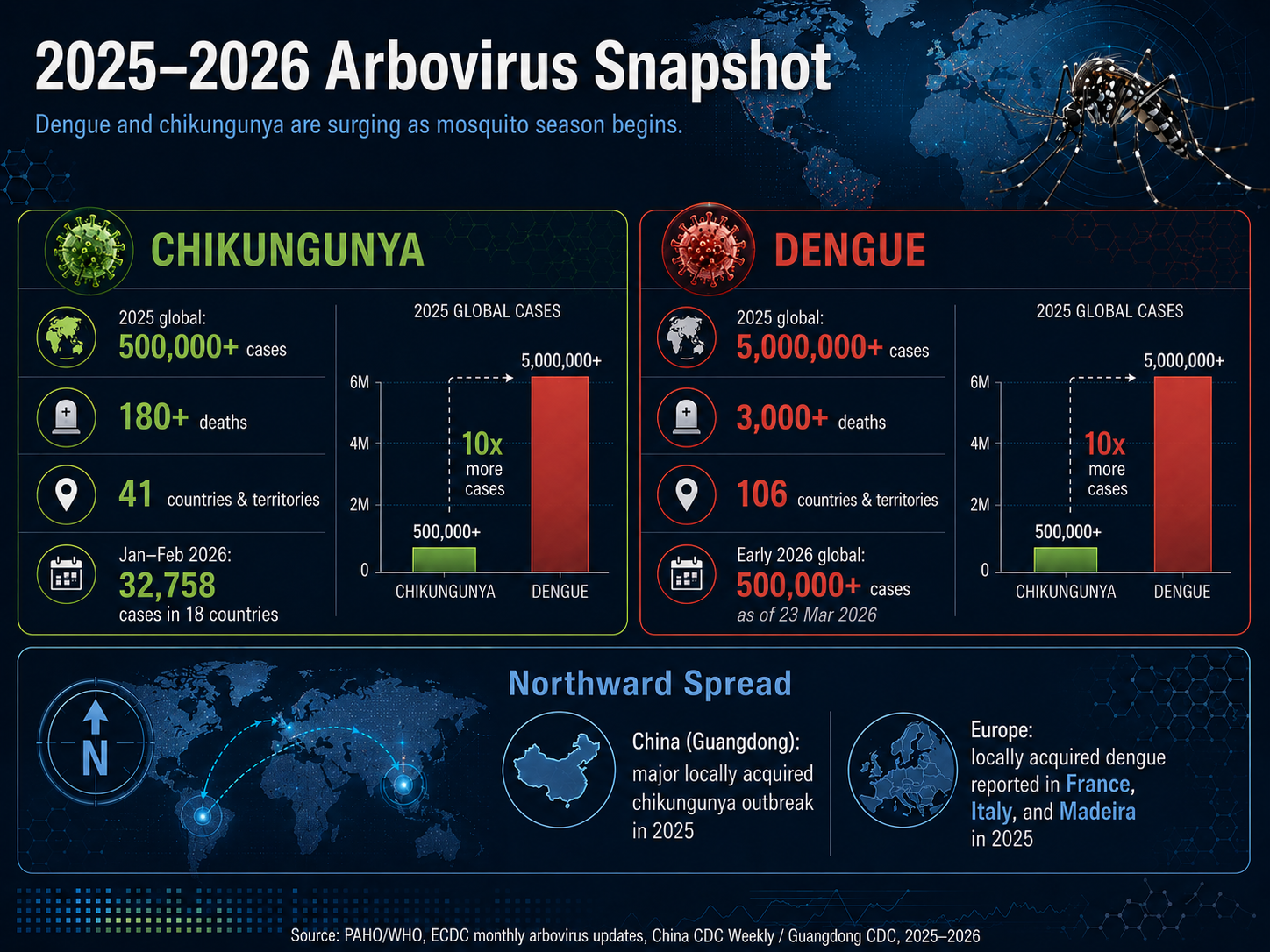
2025 was a landmark year. According to PAHO, more than 500,000 chikungunya cases and over 180 deaths were reported worldwide across 41 countries and territories. The WHO issued an urgent call to action in July 2025, noting that the virus had by then been detected across 119 countries and territories, with roughly 5.5 million people at risk.
The momentum has carried into 2026. ECDC data show that in the first two months of the year, 18 countries in the Americas reported nearly 33,000 cases, with February rising sharply over January. Countries including Colombia, Cuba, Guatemala, Peru, and Mauritius reported their first cases of 2026. PAHO’s February 2026 alert also highlighted the re-emergence of local transmission in regions that had gone years without it, including Guyana, French Guiana, and Suriname after a decade of silence.
Dengue: Still at Historic Highs
ECDC reports that in 2025, more than 5 million dengue cases and over 3,000 deaths were recorded across 106 countries and territories. Early 2026 shows that the pressure has not let up, with more than 500,000 cases reported globally within the first months of the year.
While the Americas have declined from their 2025 peak, ECDC’s monthly overview notes that all four dengue serotypes are now co-circulating in the region, and that Timor-Leste reported roughly ten times more cases in February 2026 than a year earlier. Co-circulation of multiple serotypes is associated with a higher risk of severe disease and reinfection.
The Threat Is Moving North
Perhaps the most important shift is geographic. These are no longer “tropical-only” diseases.
In China, the Guangdong Provincial CDC reported more than 25,000 locally acquired chikungunya cases in 2025, centered on Foshan — the country’s largest community outbreak since 2010 — with spillover to neighboring regions. In Europe, ECDC records show that France and Italy reported locally acquired dengue in 2025, and locally acquired cases also appeared in Madeira.
Climate change and global mobility are extending the range of Aedes mosquitoes and creating conditions for local transmission well beyond the equatorial belt.
As the Northern Hemisphere enters its warm-season window — typically June through October — these conditions align with peak vector activity.
Why Accurate Differentiation Is the Linchpin
Because symptoms overlap, early laboratory differentiation is what turns a vague “acute febrile illness” into an actionable diagnosis. It guides clinical management, informs pregnancy risk assessment, and — critically for public health — enables outbreak containment before transmission establishes.
This is why authorities point to molecular methods. PAHO’s 2026 testing guidance notes that when there is no clear clinical suspicion, multiplex PCR is useful for early detection — precisely the scenario faced when three look-alike viruses circulate at once.
A 3-in-1 Solution Built for the Season Ahead
The Bioperfectus Zika Virus / Dengue Virus / Chikungunya Virus Real-Time PCR Kit is designed for exactly this challenge: simultaneous detection and differentiation of all three arboviruses from a single sample in one reaction.
For diagnostic laboratories, CDCs, hospital networks, and border-screening programs, a consolidated multiplex workflow streamlines testing, conserves sample and reagent, and shortens the path to a confident result during the critical early window.
As the mosquito season opens across the Northern Hemisphere, surveillance and laboratory readiness are the first line of defense.
Learn more: Zika Virus / Dengue Virus / Chikungunya Virus Real-Time PCR Kit
References
- PAHO/WHO. Chikungunya cases increasing in several countries in the Americas; PAHO recommends preparedness. 11 Feb 2026. View source
- WHO. Chikungunya virus disease – Global situation. 2025. View source
- ECDC. Chikungunya virus disease worldwide overview (monthly). View source
- PAHO/WHO. Epidemiological Alert: Chikungunya. 10 Feb 2026. View source
- ECDC. 12-month dengue virus disease case notification rate per 100,000 population. View source
- ECDC. Dengue worldwide overview (monthly). View source
- Guangdong Provincial CDC. 2025 Guangdong chikungunya outbreak reports, cumulative figures as of 11 Nov 2025.
- PAHO/WHO. Epidemiological Update: Dengue in the Americas Region – laboratory testing algorithm. 18 Feb 2026. View source
