Vaginitis in Focus | Part 1: Diagnosis and antimicrobial stewardship
Accurate diagnosis supports two equally important decisions: when to treat, and when to investigate further before prescribing.
Vaginal itching, discharge and odor can prompt an immediate prescription. Yet a symptom describes a patient's experience; it does not establish its cause. The clinical challenge is to turn that experience into a defensible diagnosis and a treatment decision that addresses it.
This first article in Vaginitis in Focus examines the connection between diagnostic uncertainty and inappropriate anti-infective use. It begins with a community-practice study, then considers what its findings mean for clinical and laboratory teams.
The evidence behind the discussion

Hillier et al. (2021) enrolled 303 symptomatic women at eight UPMC-affiliated community clinics in the Pittsburgh region; 290 were evaluable. Recruitment occurred in 2017–2018. This was a regional observational study, not an international trial. Research laboratory results were withheld from treating clinicians.
BV required Nugent ≥7 plus a positive molecular panel; VVC required culture–panel concordance; TV required two positive molecular assays. Thus, microscopy contributed to the reference framework but was not the sole standard.
A treatment gap in both directions
The authors reported inappropriate treatment in 42% of evaluable women. This includes missed or mismatched therapy; it is not a 42% misdiagnosis rate or an antibiotic-overuse rate (Hillier et al., 2021).
Precision prescribing has two obligations. One is to avoid exposing a patient to an agent without a supported indication. The other is to recognize a treatable condition and select an appropriate therapy. A quality measure that counts only prescriptions avoided would miss the second obligation.
Antibiotics and antifungals should also remain distinct in this discussion. Both are anti-infectives, but they address different causes. The broader term “inappropriate anti-infective use” captures the study's scope more faithfully than “antibiotic abuse.”
What the prescribing data reveal
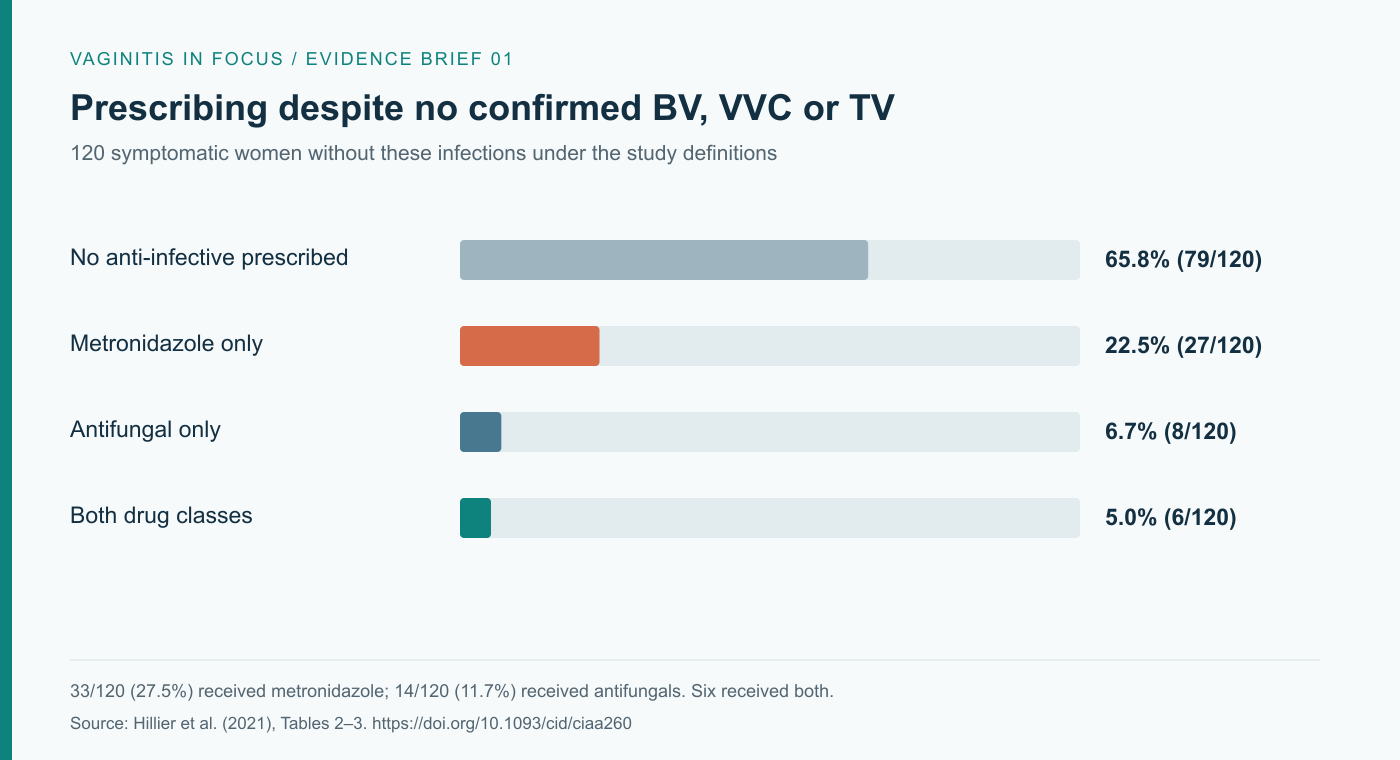
Figure 1. Original visualization of reported prescribing counts. Categories are mutually exclusive; all percentages use N = 120. Source: Hillier et al. (2021), Table 3 and accompanying results.
Among 120 women without confirmed BV, VVC or TV, 41 received anti-infectives: 27 metronidazole alone, eight antifungals alone and six both. Antibiotic exposure therefore affected 33/120 (27.5%), whereas any anti-infective exposure affected 41/120 (34.2%) (Hillier et al., 2021).
These are different stewardship measures. Reporting the denominator and the drug class makes the clinical question visible: are we evaluating unnecessary antibacterial exposure, unnecessary antifungal exposure, or the overall match between diagnosis and treatment?
Equally, a negative workup for these three conditions should not become a label that the patient's symptoms are unexplained or unimportant. It should prompt consideration of test limitations, sampling, alternative diagnoses and an appropriate follow-up plan.
Return visits a signal, not proof of harm
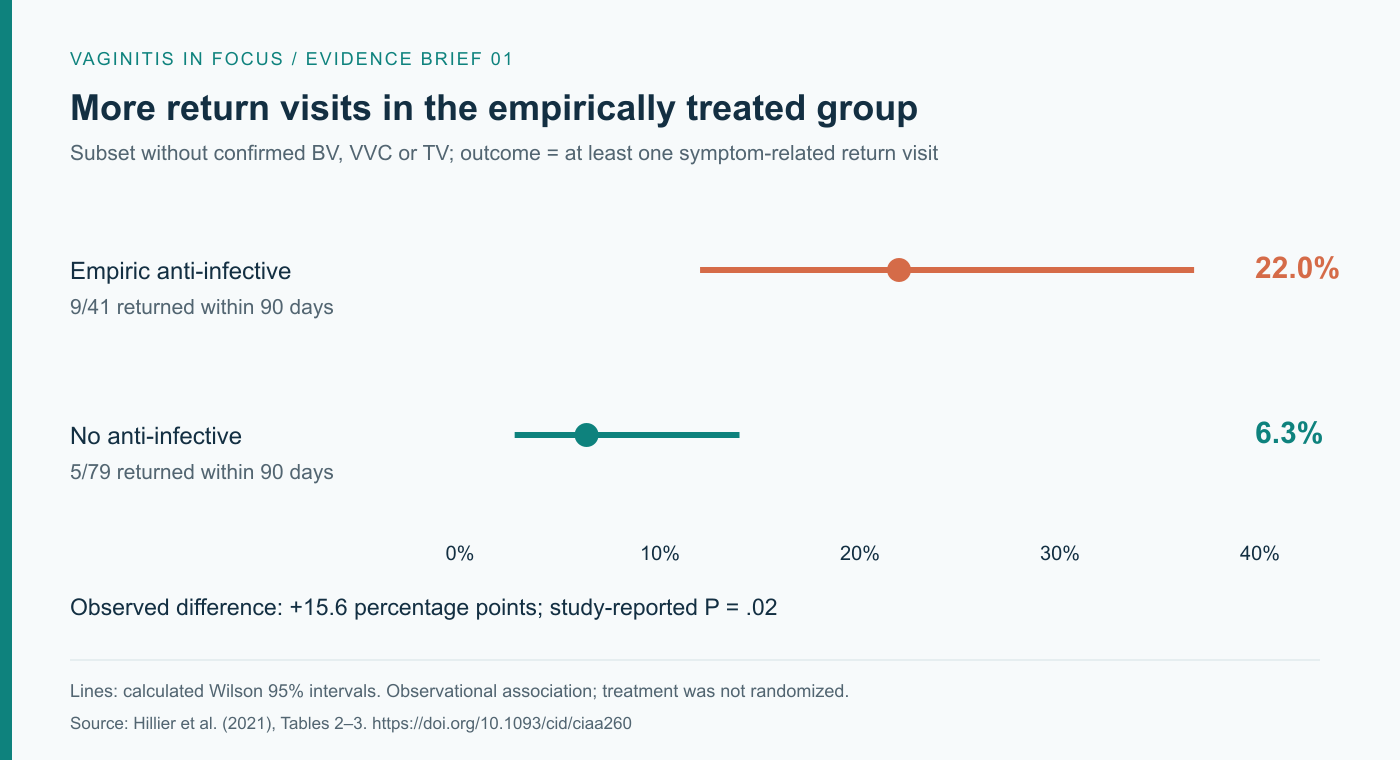
Figure 2. At least one symptom-related return visit within 90 days. Point estimates and Wilson 95% confidence intervals were calculated from published counts; P = .02 was reported by the authors. Source: Hillier et al. (2021), Table 3.
Return visits occurred in 9/41 treated versus 5/79 untreated women in that subgroup: 22.0% versus 6.3%, a calculated difference of 15.6 percentage points (Hillier et al., 2021).
The association does not show that treatment caused persistence, recurrence or additional visits. Treatment was not randomized; initial severity and other differences could influence both prescribing and follow-up. A symptom-related visit is also not a laboratory-confirmed recurrence.
The practical implication is a question for service improvement: when symptoms persist, does the next encounter revisit the diagnosis, or simply repeat the original prescription? A structured reassessment can make the uncertainty explicit and guide the next investigation.
The diagnostic process matters as much as ordering a test
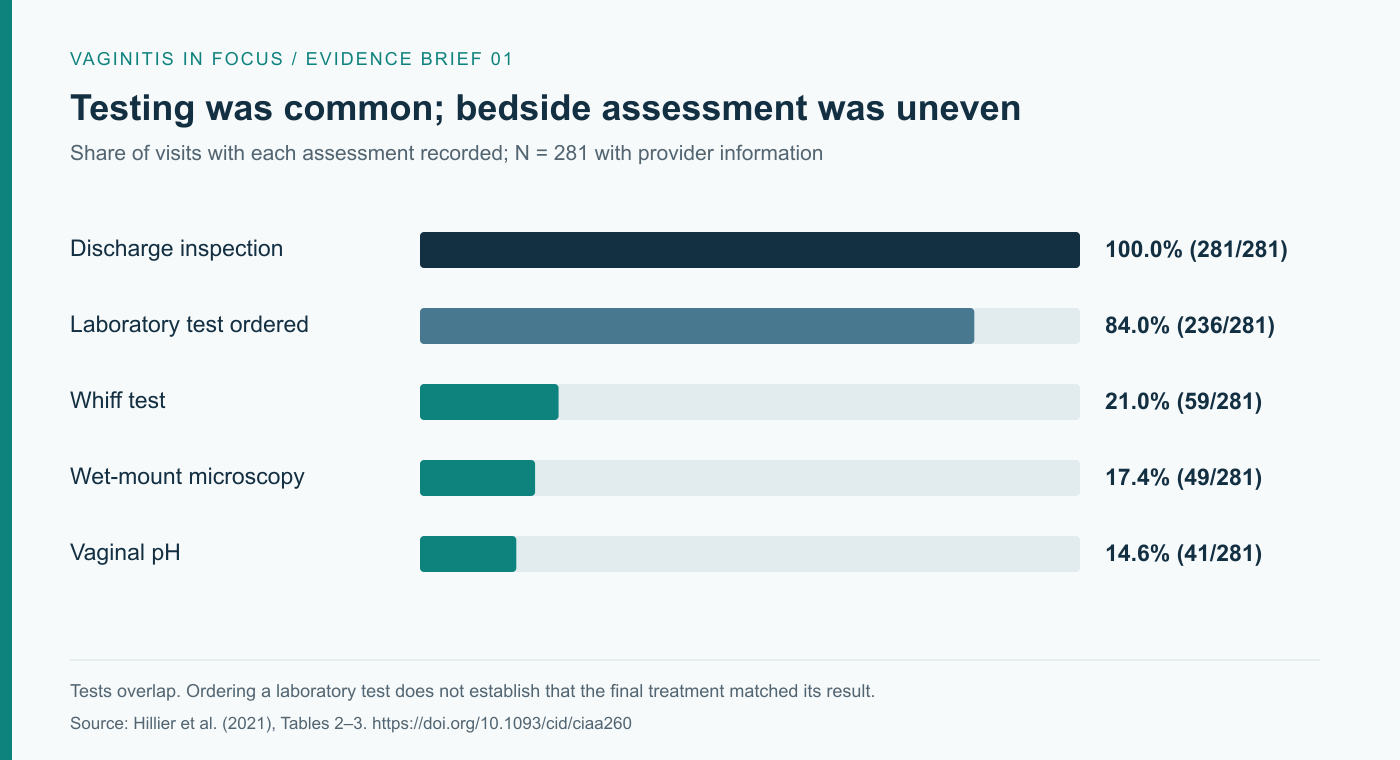
Figure 3. Recorded assessments among 281 visits with provider information. Tests overlap and percentages must not be added. Source: Hillier et al. (2021), Table 2.
Laboratory testing was ordered in 84.0% of these visits, while wet-mount microscopy was recorded in 17.4% (Hillier et al., 2021).
Low bedside-test use should therefore not be interpreted as an absence of laboratory testing. A more useful quality question is whether the complete diagnostic process supports the eventual prescription: an appropriate sample, a suitable method, a result interpreted in context and a reliable route for treatment review.
CDC guidance emphasizes that history alone is insufficient to establish the cause of vaginitis. Examination and testing help distinguish overlapping presentations. Vaginal pH, KOH testing and microscopy can contribute, but pH is nonspecific and a negative wet mount does not exclude yeast or trichomoniasis (Centers for Disease Control and Prevention [CDC], 2021b).
Precision diagnosis combines complementary evidence
For BV, Gram-stain morphology and Nugent scoring characterize the balance of bacterial morphotypes; Amsel criteria integrate clinical and microscopic findings. Validated molecular assays offer another approach in symptomatic women (CDC, 2021a).
For suspected VVC, budding yeast, hyphae or pseudohyphae can support diagnosis. When wet-mount findings are negative despite suggestive symptoms, culture may be appropriate. Conversely, detecting Candida without compatible symptoms or signs does not itself justify treatment (CDC, 2021c).
The objective is not to name one technology as sufficient for every patient. It is to reduce uncertainty at the point where a treatment decision must be made. Laboratory sensitivity, specimen quality, clinical context and the possibility of noninfectious disease all belong in that decision.
Translating evidence into a better prescribing pathway
An evidence-informed approach for clinical and laboratory teams is to:
- Define the diagnostic question. Document symptoms, examination findings, relevant exposures and prior treatment before assuming a cause.
- Use appropriate objective evidence. Select and interpret microscopy, culture or validated molecular testing according to the suspected condition and clinical setting.
- Connect the result to the prescription. Establish how pending results will be reviewed and how treatment will be adjusted when the initial impression is unsupported.
- Reassess persistent symptoms. Review alternative causes and diagnostic limitations before repeating anti-infective courses.
These are service-design implications, not interventions tested by the Hillier study. Empiric treatment can still be appropriate in selected circumstances; for example, CDC guidance allows it for suspected VVC when cultures cannot be performed after a negative wet mount (CDC, 2021c). Stewardship requires a reasoned indication and follow-up, rather than a blanket prohibition.
Reading the evidence responsibly
The findings come from one regional health system and an earlier diagnostic era. Outside-system care and over-the-counter treatment were not fully captured. NIH and an investigator-initiated BD grant supported the study. Its results should not be presented as a current global prevalence estimate of inappropriate prescribing (Hillier et al., 2021).
Nor did the study establish that a particular diagnostic platform reduces antibiotic resistance, improves the vaginal microbiome or prevents recurrent disease. Those outcomes require their own evidence.
The clinical priority a diagnosis that changes care
Accurate vaginitis diagnosis matters because the next prescription depends on it. The goal is an appropriate treatment for a supported cause, alongside a clear plan when no treatable infection has been established. For laboratories and clinicians, precision diagnosis becomes valuable when it improves that decision—not simply when it produces another result.
Next in Vaginitis in Focus: Aerobic Vaginitis Improving Diagnosis and Clinical Management. Part 2 will examine the clinical challenges surrounding AV and opportunities to improve its diagnostic assessment and management. Part 3 will consider comprehensive vaginal microecology assessment through Chinese expert consensus, followed by BioPerfectus diagnostic solutions in Part 4.
References
Centers for Disease Control and Prevention. (2021a). Bacterial vaginosis. In Sexually transmitted infections treatment guidelines, 2021. https://www.cdc.gov/std/treatment-guidelines/bv.htm
Centers for Disease Control and Prevention. (2021b). Diseases characterized by vulvovaginal itching, burning, irritation, odor or discharge. In Sexually transmitted infections treatment guidelines, 2021. https://www.cdc.gov/std/treatment-guidelines/vaginal-discharge.htm
Centers for Disease Control and Prevention. (2021c). Vulvovaginal candidiasis. In Sexually transmitted infections treatment guidelines, 2021. https://www.cdc.gov/std/treatment-guidelines/candidiasis.htm
Hillier, S. L., Austin, M., Macio, I., Meyn, L. A., Badway, D., & Beigi, R. (2021). Diagnosis and treatment of vaginal discharge syndromes in community practice settings. Clinical Infectious Diseases, 72(9), 1538–1543. https://doi.org/10.1093/cid/ciaa260
