Every respiratory season, laboratories receive a flood of specimens, and “flu positive” is rarely the end of the story. Influenza A and influenza B are different viruses with different classification schemes, and public health systems track them separately. A laboratory that can only say “influenza detected” leaves useful information on the table.
This article looks at the problem from the bench: how RT-PCR (reverse transcription polymerase chain reaction) separates the two types, why that separation feeds surveillance, and what to check when choosing an assay.

Why Does Influenza A vs. Influenza B Differentiation Matter in the Laboratory?
Differentiation matters because the two types are classified differently, and surveillance data is organized around that difference. Influenza A is divided into subtypes based on two surface proteins, hemagglutinin (H) and neuraminidase (N), and H1N1 and H3N2 currently circulate in people. Influenza B has no subtypes. It splits into two lineages, B/Yamagata and B/Victoria.
Influenza B is not a minor player. A study covering 29 countries found that influenza B caused a median of 23% of seasonal influenza cases. A laboratory that does not separate the two types would blur nearly a quarter of its positive results into one category.
| Feature |
Influenza A |
Influenza B |
| Classification |
Subtypes (H and N proteins) |
Lineages (B/Victoria, B/Yamagata) |
| Subtypes in current human circulation |
H1N1, H3N2 |
None (lineage-based) |
| Reporting need |
Type, then subtype |
Type, then lineage |
Why Is a Generic “Flu Positive” Result Not Enough?
A generic positive result does not provide the type-level detail needed for further influenza subtyping or lineage characterization. For example, one state public health laboratory reports influenza A, influenza A subtype, influenza B, and influenza B lineage as separate results. That structure only works if the first step identifies the type correctly.
Clinical guidance points the same way. The CDC (Centers for Disease Control and Prevention) recommends molecular influenza testing for all hospitalized patients with suspected influenza. A type-level result provides an important starting point for further influenza characterisation and surveillance.
How Does a PCR Test for Flu Identify and Separate Influenza A and B?
A PCR test for flu separates the two types by amplifying gene regions that are conserved within each type. The CDC explains that RT-PCR identifies influenza A and B viruses by targeting conserved gene regions. The “RT” step first converts viral RNA into DNA, so the assay can amplify it.
How Does PCR Compare With Rapid Testing?
PCR is the more sensitive and specific method. The Iowa State Hygienic Laboratory describes RT-PCR as more sensitive and specific than point-of-care rapid tests. For that reason, public health laboratories use PCR as the reference method for surveillance specimens.
Is One Multiplex Assay Better Than Two Separate Runs?
A multiplex assay is more economical in bench time, because one reaction reports both targets. Multiplexing is already standard practice. For example, the CDC’s Flu SC2 multiplex assay uses three primer/probe sets to detect and differentiate SARS-CoV-2, influenza A, and influenza B.
| Approach |
Reactions per specimen |
Pipetting and plate setup |
Result |
| Two single-target assays |
2 |
Doubled |
Two separate readouts |
| One multiplex assay |
1 |
Single setup |
Influenza A and B in one run |
What Role Does Influenza A and B PCR Play in Surveillance?
Influenza A and B PCR results contribute to global influenza surveillance by helping laboratories identify and track circulating virus types. The WHO-led Global Influenza Surveillance and Response System (GISRS) has operated for over fifty years and monitors seasonal influenza A and B viruses, including the genetic characterisation of circulating strains.
The flow is straightforward. National influenza centres test clinical specimens and share viruses with WHO Collaborating Centres, which lets WHO recommend the composition of the next season’s vaccine. Accurate typing at the first step keeps that chain reliable.
What Did the Disappearance of B/Yamagata Teach Laboratories?
It showed that lineage-level tracking changes real decisions. B/Yamagata circulation has not been confirmed since March 2020, and every type B virus with an assigned lineage since then has been B/Victoria. Surveillance laboratories could only reach that conclusion because they kept typing and characterising influenza B.
Before the disappearance, uncertainty about B lineages caused practical trouble. Lineage mismatches between vaccine and circulating strains were common, occurring in more than 40% of seasons in temperate countries. Consistent laboratory data is what makes that kind of problem visible.
How Does the BioPerfectus Influenza A and B Viruses Real Time PCR Kit Support This Workflow?
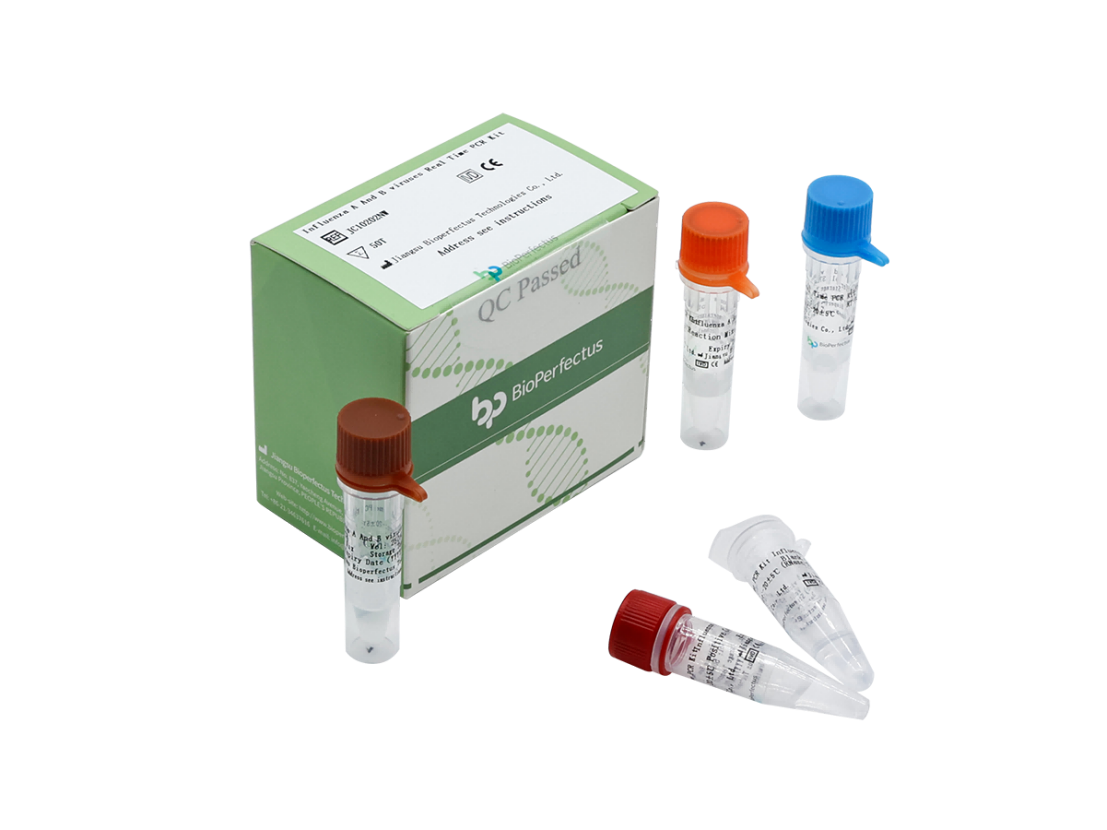
The kit gives routine laboratories a way to run the type-level step in a single reaction. BioPerfectus is a molecular diagnostics company that serves laboratories in more than 100 countries and regions, and its portfolio spans real-time PCR kits, instruments and extraction systems. The Influenza A and B Viruses Real Time PCR Kit is the company’s CE-IVD (CE-marked in vitro diagnostic) multiplex assay for this purpose.
What Does the Kit Detect, and in Which Specimens?
The kit qualitatively detects Influenza A and Influenza B RNA in one assay and includes an internal control that monitors the testing process. Accepted specimens are throat swabs, nasal and pharyngeal secretions, and cell culture supernatant.
Because the assay reports type only, laboratories that need subtype or lineage information would add a separate characterisation step, as in the tiered workflow described above.

What Performance and Throughput Data Should Laboratories Know?
The kit reports the following figures:
| Parameter |
Influenza A |
Influenza B |
| Clinical sensitivity |
96.1% |
97.5% |
| Clinical specificity |
98.7% |
98.2% |
The reported limit of detection is 2.0 TCID50/mL, with a template input volume of 5 μL per reaction. A run processes 96 tests in 109 minutes on compatible real-time PCR instruments, and the catalog number JC10202NW comes in 25-test and 50-test kits.
Laboratories building a wider respiratory menu can also explore the BioPerfectus influenza testing portfolio, which ranges from rapid tests to real-time PCR kits.
Conclusion: What Should Laboratories Take Away?
Separating influenza A from influenza B is a basic requirement of modern influenza testing. The two types are classified differently, they appear in surveillance data separately, and the B/Yamagata story shows what accurate typing makes possible.
A multiplex PCR test for flu reduces the work to one reaction per specimen. When evaluating influenza A and B PCR options, compare sensitivity, specificity, limit of detection, accepted specimen types and run time side by side. The BioPerfectus Influenza A and B Viruses Real Time PCR Kit reports all of these, and you can learn more about the company at BioPerfectus.
References
