Automated nucleic acid extraction is widely used in molecular diagnostics workflows. These systems replace many repetitive manual pipetting steps with standardized, walk-away protocols, helping laboratories improve workflow consistency and reproducibility across routine sample volumes.
Yet when choosing an automated nucleic acid extraction machine, one of the most common decision points is throughput: 48 samples per run or 96? The answer depends on more than just the number on the spec sheet.
Key Takeaways
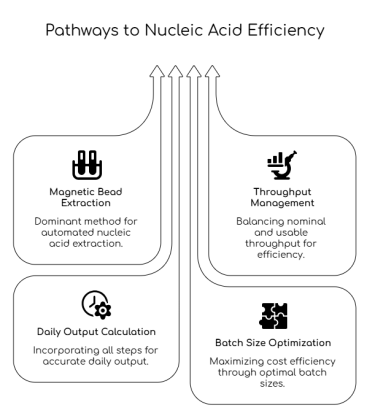
- Many automated nucleic acid extraction systems use magnetic bead-based purification.
- Nominal throughput is not always usable throughput; extraction controls and reserved positions may reduce the number of clinical samples per run.
- A 48-position system often suits variable or mid-volume batches, while a 96-position system is more efficient for consistently high-volume workflows.
- BioPerfectus is a molecular diagnostics company offering automated solutions for laboratory workflows. SAW-48 and SAW-96 automated nucleic acid extraction workstations are recommended for laboratories seeking flexible medium- to high-throughput processing.
A Quick Look at BioPerfectus’ SAW Series Automated Nucleic Acid Extraction Workstations
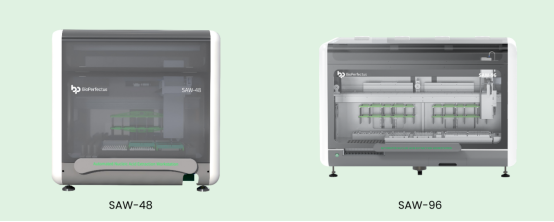
Before diving into the technical discussion, it is worth noting that BioPerfectus offers two walk-away nucleic acid extraction instruments designed for mid-to-high throughput laboratories:
Both models integrate sample loading, nucleic acid purification, and PCR setup into a single enclosed workstation. Throughout this article, they serve as practical reference points for illustrating the workflow considerations behind 48- versus 96-sample throughput.
How Automated Nucleic Acid Extraction Works
Many modern automated nucleic acid extraction instruments use magnetic bead-based separation. While protocols and consumables vary by manufacturer and sample type, the workflow generally follows four steps:
- Lysis. The sample is mixed with a lysis buffer, often with proteinase K and, in some protocols, controlled heating, to disrupt cells or viral particles and release nucleic acids.
- Binding. Under kit-specific buffer conditions, nucleic acids bind reversibly to magnetic particles with silica, cellulose, carboxylated, or other proprietary surface chemistries.
- Washing. A magnet immobilizes the bead-bound nucleic acids while one or more wash buffers remove proteins, salts, lipids, detergents, and other potential contaminants or PCR inhibitors.
- Elution. The purified DNA or RNA is released from the beads into water or an elution buffer for downstream applications such as PCR, RT-qPCR, digital PCR, or sequencing.
Instrument capabilities vary widely by model, extraction kit, plate format, and protocol. Key specifications to compare include supported sample-input volume, throughput, run time, heating range, contamination-control features, and the validated sample types and downstream assays.
Understanding Throughput: More Than a Number
Nominal Capacity vs. Usable Capacity
A 48-position or 96-position extraction instrument does not automatically translate into 48 or 96 reportable patient results per run. Depending on the assay, the manufacturer’s instructions for use (IFU), local regulatory requirements, and laboratory SOPs, an extraction batch may include extraction controls, repeat specimens, or reserved positions for contingency samples.
Calibrators, standard curves, and technical replicates are often part of the downstream PCR or quantitative analysis workflow rather than the extraction plate itself. In addition, internal process controls may be added to every patient specimen without occupying separate extraction positions.
Usable sample capacity per run = Nominal extraction positions − dedicated extraction controls − repeat or reserved positions
For example, if a 96-position extraction run reserves eight positions for extraction controls and contingency samples, it can process up to 88 clinical specimens. If a 48-position run reserves four positions, it can process up to 44 clinical specimens. These are illustrative examples; the actual layout must follow the validated assay workflow.
Daily Throughput Depends on the Entire Workflow
Single-run capacity is only one part of laboratory productivity. End-to-end throughput can also be affected by:
- Sample accessioning, pretreatment, and barcode verification
- Reagent preparation, deck loading, and consumable loading
- Extraction, washing, elution, and plate sealing
- PCR or sequencing-library setup
- Downstream instrument availability
- Cleaning, decontamination, consumable changeover, reruns, and quality-control review
Daily throughput = Usable samples per completed run × Completed runs per shift
In practice, completed runs per shift depend on total cycle time, hands-on time, staffing, instrument uptime, sample-arrival patterns, and downstream PCR or sequencing capacity. A 48-position system may offer faster turnaround for small, frequently arriving batches, while a 96-position system will usually deliver higher overall sample output when it runs at high utilization.
Batch Size Economics
The most economical throughput depends on how consistently a laboratory can fill each run.
- Typical batches of 30–40 samples: A 48-position system may provide a better operational fit, especially when fast turnaround is more important than waiting to accumulate a larger batch. A 96-position workflow may have a higher cost per reportable sample if it requires full-plate or non-divisible reagent and consumable formats.
- Typical batches of 80 or more samples: A 96-position system can often process the batch in one run, avoiding a second extraction cycle and reducing associated setup and hands-on time.
The guiding principle is to match capacity to the laboratory’s typical batch size, target turnaround time, validated workflow, and expected growth—not only to occasional peak demand.
Selection Guidance: When Each Throughput Tier Fits
Scenarios Favoring 48-Sample Throughput
- Mid-volume clinical labs running 1–48 samples per batch, where near-full utilization keeps per-sample costs low.
- Space-constrained settings. Compact instruments (e.g., the SAW-48 at 740 × 650 × 730 mm, 50 kg) can fit into tighter bench layouts.
- Time-sensitive reporting. A sub-45-minute turnaround from sample to PCR-ready eluate can support same-day result commitments.
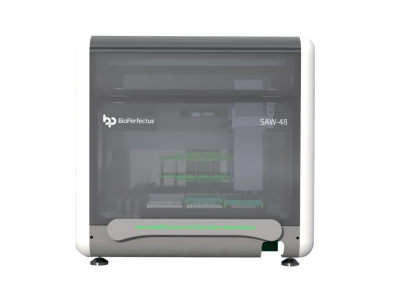
Automated Nucleic Acid Extraction Workstation SAW-48
Scenarios Favoring 96-Sample Throughput
- High-volume testing centers and public health laboratories processing 80+ samples per batch and prioritizing daily output.
- Population screening programs (HPV, respiratory panels, STI screening) with predictable daily sample pools.
- Growth-oriented labs where current volumes are moderate but projected increases could eventually exceed the capacity of a 48-position platform.
Automated Nucleic Acid Extraction Workstation SAW-96
| Specification |
SAW-48 |
SAW-96 |
| Samples per run |
1–48 |
1–96 |
| Full-process run time |
<45 min |
<70 min |
| Dimensions (L × D × H) |
740 × 650 × 730 mm |
1,130 × 680 × 690 mm |
| Weight |
50 kg |
110.8 kg |
| Rated power |
420 VA |
1,210 VA |
Both share the same core capabilities: magnetic bead-based extraction with ≥ 98% bead recovery, 1–2 sample loading channels, ±0.1 mm positional accuracy, reagent cooling at 4–15 °C, and PCR setup cooling at 4–8 °C. Both models carry NMPA registration and CE marking and are listed with the U.S. FDA.
A notable observation: the SAW-96 handles twice the sample count but completes its full workflow in under 70 minutes, not double the SAW-48's 45-minute cycle.
A Practical Example
Consider a laboratory processing 150 samples during an 8-hour shift:
- With SAW-48: At a maximum throughput of 48 samples per run, 150 samples require 4 runs. With a typical whole-process run time of less than 45 minutes, the total instrument run time is less than 180 minutes.
- With SAW-96: At a maximum throughput of 96 samples per run, 150 samples require 2 runs. With a typical whole-process run time of less than 70 minutes, the total instrument run time is less than 140 minutes.
Both configurations can process 150 samples within a single 8-hour shift. SAW-96 requires fewer runs and loading cycles, while SAW-48 has a smaller footprint and lower rated power requirement.
Conclusion
Selecting between 48- and 96-sample throughput is a workflow decision, not merely a capacity decision. The right automated nucleic acid extraction machine aligns with actual batch sizes, daily volumes, bench space, validated assay requirements, and downstream instrument capacity.
A structured evaluation approach can simplify the process:
- Calculate the usable sample count per extraction run after accounting for dedicated extraction controls, repeat specimens, and reserved positions. Include calibrators or standards where required by the downstream assay.
- Estimate end-to-end workflow time, including sample preparation, loading, extraction, PCR setup, decontamination, and batch changeover.
- Model daily throughput against staffing hours, instrument uptime, and downstream instrument availability.
- Compare per-sample consumable and operating costs at typical and peak batch sizes.
By working through these steps, laboratories can identify the throughput tier that delivers an appropriate cost per reportable result at their current operating scale, while maintaining the quality, turnaround time, and scalability needed for future growth.
Disclaimer: This article is for general informational and educational purposes only and does not constitute medical, laboratory, regulatory, or other professional advice. For specific product information and application requirements, please refer to official product documentation, applicable regulations, and laboratory SOPs.
