Why Does Nucleic Acid Extraction Method Choice Matter for Automated Workflows?
The extraction method a lab picks can affect how far it can scale testing without adding staff. Manual pipetting steps introduce hands-on time, operator variability, and contamination risk. As sample volumes grow, these bottlenecks compound.
That's why choosing an automated nucleic acid extraction machine is rarely just an equipment upgrade — it's a workflow redesign. The extraction chemistry underneath that machine, whether bead-based or column-based, shapes what automation is possible.
Common pain points labs face before automating:
- Long hands-on time per batch, limiting daily sample capacity
- Cross-contamination risk from repeated tube transfers
- Inconsistent yields between operators or shifts
- Difficulty scaling from research volumes to routine clinical volumes
What Is the Difference Between Magnetic Bead and Spin Column Extraction?
Both methods purify nucleic acids by binding deoxyribonucleic acid (DNA) or ribonucleic acid (RNA) to a solid surface, washing away contaminants, then releasing the purified material. The surface they use, and how it is separated from the sample, is where the two methods diverge.
How Does Spin Column Extraction Work?
Spin column extraction binds nucleic acids to a silica membrane inside a small column under high-salt conditions. A centrifuge then spins the column to force liquid through the membrane at each wash and elution step.
This method is straightforward on the bench because most labs already own a centrifuge. However, centrifugation is a batch process tied to a specific rotor size, which makes it harder to hand off to a robotic liquid handler.
How Does Magnetic Bead Extraction Work?
Magnetic bead nucleic acid extraction uses magnetized particles coated with a nucleic-acid-binding surface instead of a membrane. A magnet pulls the beads, together with the nucleic acids attached to them, out of solution at each wash step, replacing the centrifuge entirely.
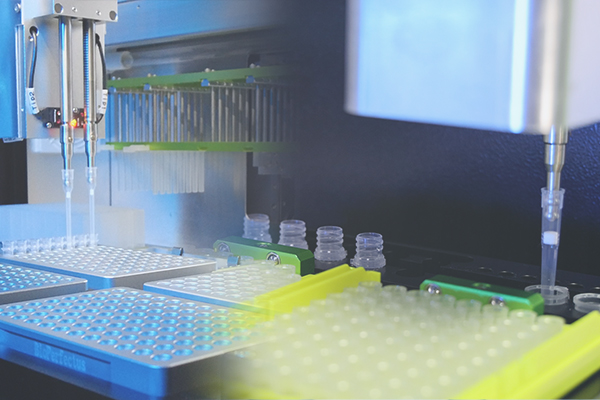
Because magnetic separation can be integrated directly into robotic workflows, this separation step is well suited to automation. Automated extraction workflows commonly use magnetic beads because the beads can be manipulated directly by robotic systems.
Why Is Magnetic Bead Extraction Better Suited to Automation?
Magnetic bead extraction fits automated instruments more naturally because it removes the centrifuge from the process. Spin columns depend on that centrifugation step, and centrifuges can be more difficult and costly to integrate into a robotic platform.
What Happens When Labs Try to Automate Spin Columns?
Automating spin columns generally means adding centrifuge-handling robotics on top of the existing method. This can increase automation complexity because the centrifugation requirement must be incorporated into the workflow.
How Do Magnetic Beads Solve the Automation Problem?
Magnetic separation replaces the centrifuge with a magnetic separation step, allowing a liquid-handling robot to complete wash-and-elute cycles without relying on centrifugation. Magnetic bead-based workflows may therefore be easier to integrate into automated systems, although protocol optimization may still be needed to achieve target yields.
| Factor |
Spin Column |
Magnetic Bead |
| Core separation step |
Centrifugation |
Magnetic field |
| Automation complexity |
Higher (requires centrifuge integration) |
Lower (magnetic separation + pipetting) |
| Typical use case |
Manual, low-volume benchwork |
Automated, walk-away systems |
| Common challenge |
Harder to scale to automation |
May need protocol optimization for yield |
How Does BioPerfectus's SAW-48 Apply Magnetic Bead Automation in Practice?
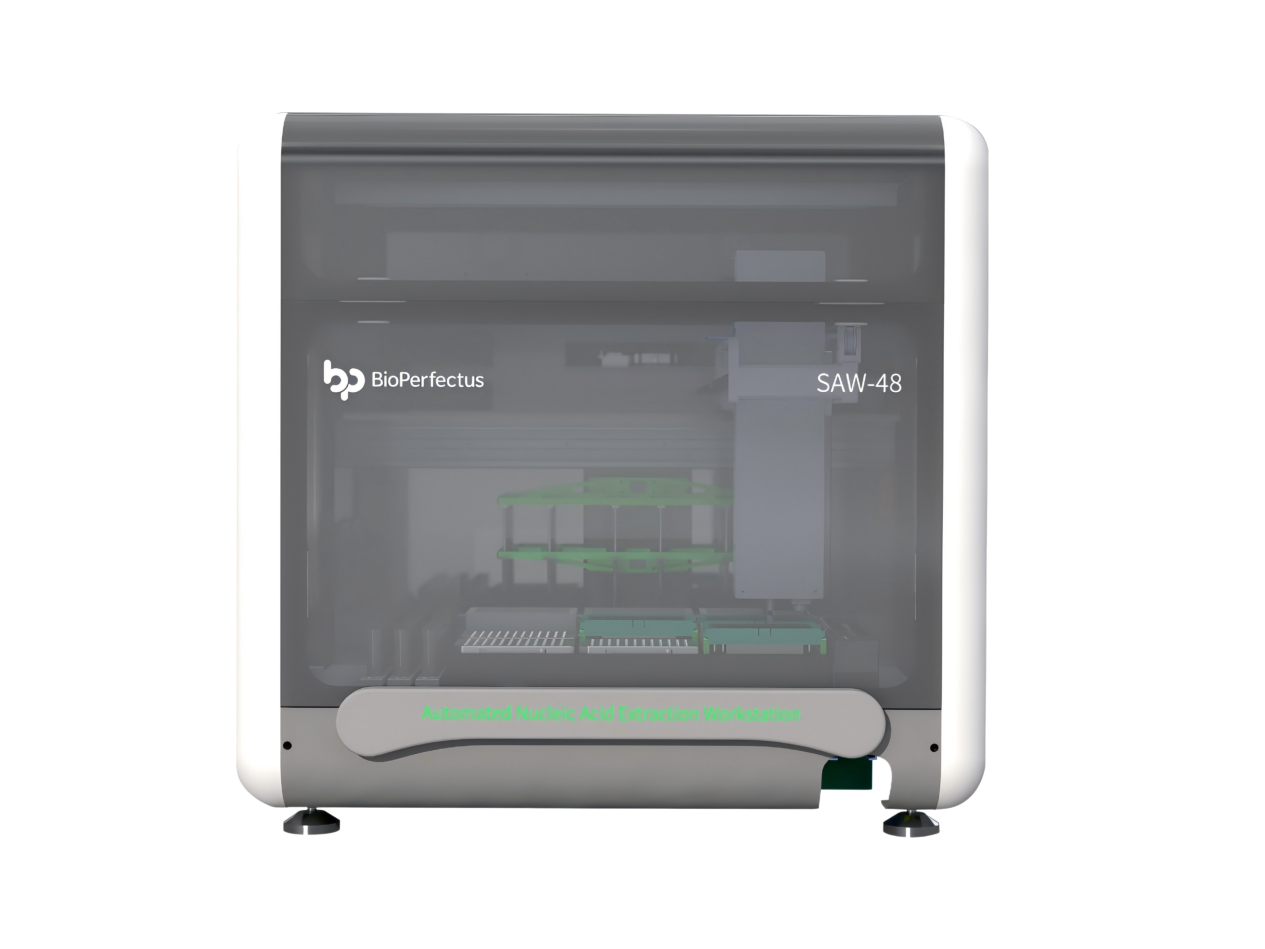
BioPerfectus's Total PCR Solution pairs nucleic acid extraction workstations with real-time polymerase chain reaction (PCR) systems. The Automated Nucleic Acid Extraction Workstation SAW-48 is the extraction component of that workflow. It is built on magnetic separation technology and integrates multiple automated sample-processing steps in a benchtop system.
What Does the SAW-48 Actually Do, Step by Step?
The SAW-48 moves a sample from its primary tube to a PCR-ready tube without manual handling between major workflow stages. It combines sample loading, magnetic bead-based purification, and PCR reaction setup within one walk-away sequence.
According to the manufacturer's published specifications:
- Processes 1–48 samples in under 45 minutes
- Magnetic bead recovery efficiency of ≥98%
- Processing volume of 20–1,000 µL
- Dimensions of 740 × 650 × 730 mm and a weight of 50 kg
- Contamination-control features including ultraviolet (UV) disinfection modules, high-efficiency particulate air (HEPA) filters, and an electrostatic particulate filter, with extraction and dispensing performed in physically separate zones
Which Labs and Sample Types Is It Designed For?
The SAW-48's listed compatible sample types include plasma, serum, whole blood, swabs, and urine, and it is designed to run BioPerfectus magnetic bead-based nucleic acid extraction kits. The instrument is listed as NMPA, CE, and FDA Listed, with IVDR referenced on its product page.
How Should a Lab Choose Between Magnetic Bead and Spin Column Extraction?
The right method depends on sample volume, budget, and how much of the workflow needs to run unattended. Neither method is universally correct; each fits a different point on the throughput curve.
What Factors Should Drive the Decision?
A research lab processing a handful of samples per week may find a manual spin column kit sufficient, since the upfront cost of an automated system is harder to justify at low volume. A clinical lab processing dozens of samples daily, however, faces a different calculation because manual hands-on time and contamination risk increase as sample numbers rise.
| Lab Profile |
Likely Fit |
Why |
| Low-volume research lab |
Manual spin column |
Lower upfront cost; no automation hardware needed |
| Moderate-throughput clinical lab (1–48 samples/run) |
Automated magnetic bead workstation |
Reduces hands-on time and cross-contamination risk at scale |
| High-throughput reference lab |
Larger automated magnetic bead platforms |
Built for batch sizes beyond 48 samples |
As a result, the decision should start with a lab's actual daily sample count, rather than with which method sounds more capable on paper.

Conclusion — Choosing the Right Extraction Approach for Your Lab
Spin columns and magnetic beads can both be used to purify nucleic acids; the key difference lies in how well each method fits into an automated workflow. Magnetic separation removes the centrifuge from the process, which is one reason automated extraction platforms commonly use bead-based chemistry.
For labs evaluating that shift, reviewing published throughput, recovery, and contamination-control specifications — such as those listed for the Automated Nucleic Acid Extraction Workstation SAW-48 — is a more useful starting point than comparing marketing claims. Matching the extraction method to actual sample volume, rather than assuming one approach is universally preferable, helps determine whether automation fits a laboratory's workflow requirements.
