A patient walks into a clinic with fever and a rash. That single presentation could point to measles, rubella, dengue, Zika, or chikungunya — five viruses with five different public health implications. Labs relying on one test at a time often chase the wrong pathogen first. Multiplex polymerase chain reaction (PCR) testing changes that sequence by checking several pathogens in one reaction.

Why Are Clinicians Struggling to Diagnose Fever-and-Rash Illnesses on Symptoms Alone?
Symptoms alone are not a reliable diagnostic tool here. Fever, rash, and joint pain overlap across measles, rubella, dengue, Zika, and chikungunya, so a clinical impression is only a starting point, not a conclusion.
What Makes Measles, Rubella, Dengue, Zika, and Chikungunya Look So Similar?
These viruses share overlapping, non-specific symptoms, which may make them difficult to distinguish based on clinical presentation alone. The U.S. Centers for Disease Control and Prevention (CDC) notes that dengue, Zika, and chikungunya are transmitted by the same mosquitoes and can produce similar clinical features, including fever, rash, and joint pain. Laboratory testing can therefore be important for differentiating these infections.
What Happens When a Patient Is Tested for the Wrong Pathogen First?
Sequential single-target testing can use additional sample volume and time before a lab reaches the correct result. Research on co-circulating dengue and Zika viruses found that clinical differentiation can be challenging in areas where both viruses are circulating, supporting the role of molecular methods in laboratory confirmation. Consequently, running separate assays one after another may delay confirmation, require additional testing, and slow outbreak reporting.
What Is Multiplex PCR, and How Does It Differ From Single-Target Testing?
Multiplex PCR amplifies and detects genetic material from more than one pathogen within the same reaction well. It pairs several sets of primers and fluorescent probes, each tuned to a different target gene, so the instrument reads multiple signals from one sample at once.
How Does One Reaction Detect Multiple Pathogens at Once?
A single specimen — a throat swab or blood sample, for example — is added to a reaction mix containing primers for each target organism, plus an internal control such as RNase P, a human gene used to confirm that the reaction worked. Because each target carries its own fluorescent marker, the instrument distinguishes which pathogen is present without splitting the sample into separate tubes.
Single-Pathogen Testing vs. Syndromic Panels
| Factor |
Single-Pathogen PCR |
Multiplex/Syndromic PCR |
| Sample volume needed |
One aliquot per target |
One aliquot for all targets |
| Turnaround for a full differential |
Multiplied by number of tests ordered |
One run covers the panel |
| Best suited for |
A single, already-suspected pathogen |
Overlapping-symptom presentations |
| Internal control |
Test-dependent |
Typically built into the panel |
How Does a Measles & Rubella Test Kit Solve the Respiratory-and-Rash Dilemma?
A combined measles and rubella test kit can assess both targets from one throat swab specimen in a single multiplex assay rather than requiring separate measles-only and rubella-only assays. This matters clinically because measles and rubella can both present with respiratory symptoms or a rash, and distinguishing them affects how a case is reported and managed.
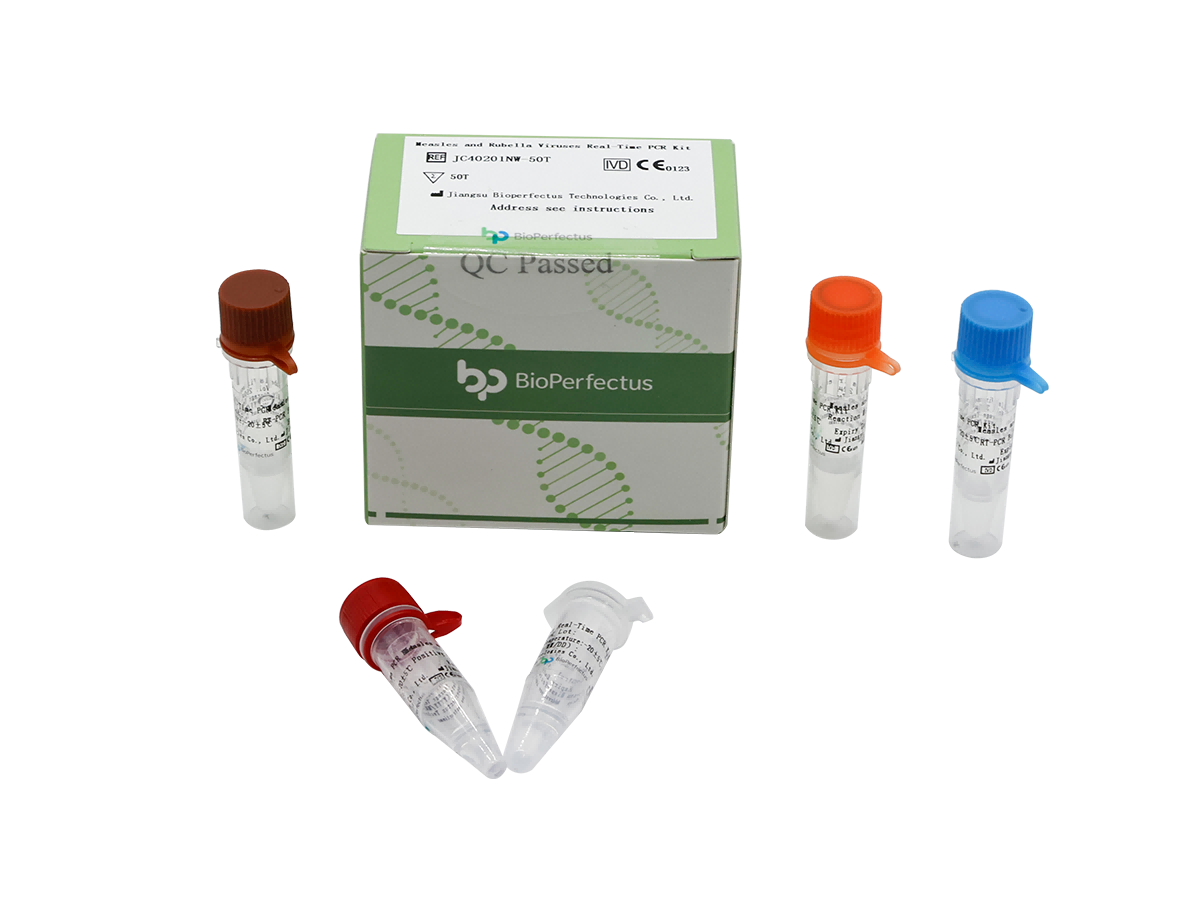
What Does the Measles and Rubella Viruses Real-Time PCR Kit Actually Detect?
The BioPerfectus Measles and Rubella Viruses Real-Time PCR Kit is an in vitro diagnostic (IVD) assay that qualitatively detects and differentiates measles virus and rubella virus nucleic acids from throat swab specimens. It targets the N gene of measles virus and the E1 gene of rubella virus, with RNase P as an internal process control. Per the manufacturer's published parameters, the assay reports 100% clinical sensitivity for both viruses, 99.5% specificity for measles and 99.6% for rubella, and a limit of detection of 10 TCID50/mL for measles and 20 TCID50/mL for rubella. TCID50 is a standard unit describing the amount of virus needed to infect 50% of test cultures.
Where Does This Fit Into a Lab's Existing Workflow?
The kit runs on compatible mainstream real-time PCR instruments already common in molecular labs, processing 96 tests in 109 minutes from a 5 µL sample input. This supports batch processing of up to 96 tests in a 109-minute workflow rather than requiring separate measles-only and rubella-only assays. It carries CE-IVDR certification and is intended for patients with respiratory or skin symptoms evaluated together with clinical and epidemiological risk factors, not as a standalone screening tool.
Global surveillance shows why this differentiation matters at scale. The World Health Organization reported roughly 10.3 million measles cases worldwide in 2023, a 20% increase over 2022, with 59 countries reporting large or disruptive outbreaks in 2024 — nearly triple the number recorded in 2021. A measles-only or rubella-only test cannot rule the other virus in or out, which is the gap a combined panel closes.
How Can Labs Tell Zika, Dengue, and Chikungunya Apart in One Test?
Vector-borne fevers create the same differentiation problem, and BioPerfectus addresses it with a dedicated triplex kit. Because dengue, Zika, and chikungunya are all transmitted by Aedes mosquitoes and often circulate in the same region at the same time, a lab testing febrile travelers or local patients frequently needs to rule out all three, not just one.
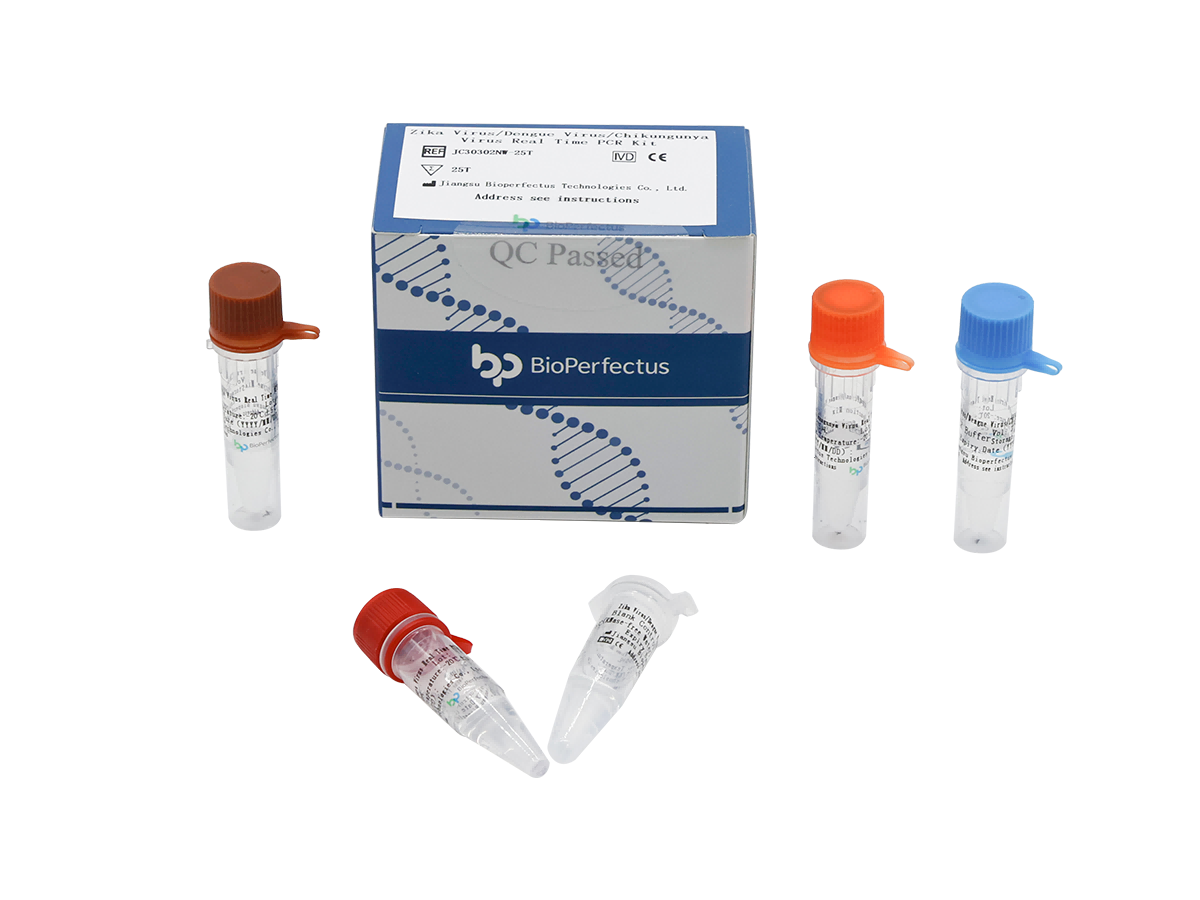
What Does BioPerfectus's Zika/Dengue/Chikungunya Kit Cover?
The BioPerfectus Zika Virus / Dengue Virus / Chikungunya Virus Real Time PCR Kit is a multiplex assay for the qualitative detection of dengue virus, chikungunya virus, and Zika virus RNA from a single sample in one workflow. Its published limit of detection is 5 copies/reaction, and it processes 96 tests in 79 minutes from a 5 µL sample input, with an internal process control included. This kit holds CE-IVD certification.
Which Sample Types Work for Which Virus?
| Sample Type |
Dengue |
Chikungunya |
Zika |
| Serum |
✓ |
✓ |
✓ |
| EDTA whole blood |
✓ |
✓ |
✓ |
| Cerebrospinal fluid (CSF) |
✓ |
✓ |
✓ |
| Urine |
— |
— |
✓ |
| Amniotic fluid |
— |
— |
✓ |
Peer-reviewed research supports why this combined approach has clinical value: molecular methods, including multiplex reverse-transcription PCR, can support differentiation where symptom-based assessment or serological approaches may be complicated by cross-reactivity between related flaviviruses. Because the three viruses share a vector and an overlapping clinical picture, testing for one and not the others can leave a case unresolved.
Single-Pathogen Detection or Syndromic Testing — Which Should a Lab Choose?
Neither approach fits every scenario, so the right choice depends on what the lab already suspects. Framing this as a spectrum, rather than a single best answer, helps a laboratory director match ordering practices to the patient population.
When Does a Targeted Test Still Make Sense?
A single-pathogen test remains appropriate when a specific virus is already confirmed locally and no other pathogens are epidemiologically likely. During a well-documented, single-strain outbreak with no co-circulating vector-borne disease, for example, a targeted assay conserves reagents without sacrificing accuracy for that specific question.
When Does a Panel-Based Approach Save More Time and Sample?
A syndromic panel fits better whenever a patient's presentation could plausibly match more than one pathogen the panel covers. This applies to febrile-rash cases where measles and rubella are both plausible, or to travelers and residents in areas where dengue, Zika, and chikungunya all circulate. Here, one sample and one run can reduce the need for multiple separate test orders.
Conclusion: Building a Molecular Testing Strategy That Matches the Pathogen Landscape
Symptom overlap is not going away, and neither is the pressure on laboratories to deliver a confirmed result quickly. Multiplex PCR does not replace clinical judgment, but it gives that judgment a specific laboratory answer from a single specimen. For respiratory-and-rash presentations, a combined measles and rubella panel addresses the differentiation question directly; for mosquito-borne fevers, a triplex dengue, Zika, and chikungunya panel does the same. Laboratories planning their next molecular testing workflow can review BioPerfectus's full molecular diagnostics portfolio to see how these panels fit alongside existing real-time PCR instruments.
References
[1] World Health Organization. Measles cases surge worldwide, infecting 10.3 million people in 2023. 2024.
[2] World Health Organization. Measles deaths down 88% since 2000, but cases surge. 2025.
[3] Waggoner JJ, Gresh L, Mohamed-Hadley A, Ballesteros G, Vargas Davila MJ, Tellez Y, et al. Single-Reaction Multiplex Reverse Transcription PCR for Detection of Zika, Chikungunya, and Dengue Viruses. Emerging Infectious Diseases. 2016;22(7):1295–1297.
