A total PCR solution connects sample preparation, nucleic acid extraction, PCR setup, amplification, and result interpretation. Selecting these components as one workflow can help a laboratory standardize routine operations, control hands-on time, and align capacity with its test menu. This guide explains the main criteria for evaluating an automated workstation, extraction reagents, qPCR system, controls, regulatory status, and lifecycle support.
Core Buying Criteria for a Total PCR Solution
- Workflow coverage: Identify the steps handled by automation and the steps that remain manual.
- Usable capacity: Calculate completed samples per shift after controls, repeats, and cleaning.
- Extraction compatibility: Match the reagent and program to each specimen type and downstream assay.
- qPCR capability: Compare block format, thermal control, optical channels, and software functions.
- Quality controls: Review internal, positive, negative, and no-template controls for each assay.
- Lifecycle support: Include consumables, storage, training, maintenance, and service in the comparison.
1. Select the Workstation Around the Full Workflow
The workstation determines how many manual steps remain between the primary sample and the PCR-ready reaction. A workflow map makes different automation platforms easier to compare.
Define the Automation Boundary
Review whether the proposed system covers:
- Sample identification, loading, and transfer
- Tube opening and closing, where applicable
- Magnetic-bead nucleic acid purification
- Master mix preparation and dispensing
- PCR setup, sealing, and transfer to the qPCR instrument
- Amplification, interpretation, and data export
The phrase “sample-to-result” can describe different levels of integration. Some workstations automate extraction and PCR setup but still require an operator to load a separate qPCR instrument. Record every handoff.
Calculate Practical Throughput
Instrument capacity and completed patient results are different measures. Practical throughput includes:
- Controls, repeats, invalid results, and confirmatory tests
- Batch size and assays per shift
- Extraction, setup, amplification, and review time
- Staffing, cleaning, maintenance, and peak periods
Compare configurations by completed samples in a defined shift rather than by nominal well count alone. A representative site test can also reveal whether extraction capacity and qPCR capacity remain balanced.
Explore more: Automated Nucleic Acid Extraction Machine: 48 vs. 96 Throughput
Examine Contamination Control
Useful workstation features can include:
- Separation between extraction and reagent-dispensing areas
- HEPA filtration and UV disinfection
- Filter tips and leak-resistant liquid handling
- Controlled airflow and scientific zoning
- Closed or sealed reactions after PCR setup
These controls work with laboratory zoning, directional workflow, cleaning, monitoring, and assay controls. When comparing automated nucleic acid extraction workstation suppliers, request a demonstration with representative materials. Record open-tube steps, manual touches, cleaning, waste handling, and error recovery.
2. Evaluate Extraction Reagents With Sample Preparation
Extraction quality affects the amount, purity, and integrity of the nucleic acid entering PCR. The reagent chemistry, specimen type, instrument program, and elution conditions therefore need to be assessed together.
Confirm Specimen Compatibility
For each assay, document:
- Validated specimen, collection device, and transport medium
- Required pretreatment, lysis, or centrifugation
- Sample input and elution volumes
- DNA, RNA, or combined DNA/RNA extraction
- Known inhibitors associated with the specimen
The extraction and downstream assay instructions need to describe a compatible process for the selected specimen.
Read Performance Terms Carefully
Magnetic-bead recovery, nucleic-acid recovery, yield, purity, and assay sensitivity are different measurements. Bead recovery describes collection of magnetic particles, not the percentage of nucleic acid recovered from a specimen.
Useful evaluation data can include:
- Recovery across relevant target concentrations
- Repeatability across wells, runs, operators, and lots
- Evidence of inhibitor removal
- Eluate stability and performance near the assay’s limit of detection
Review Reagent Logistics
Operational fit also depends on:
- Reagent format, traceability, and lot verification
- Shipping, storage, on-board stability, and remaining shelf life
- Freeze-thaw limits
- Required consumables and validated instrument programs
These factors influence hands-on time, waste, inventory planning, and cost per valid result.
3. Match the qPCR System, Assays, and Controls
The qPCR system can be selected against the planned assay menu, batch pattern, multiplexing needs, and data-management process.
Compare the Core Hardware
Review the following specifications in the context of the intended assays:
- Block format: Standard 96-well, higher-density, rotary, or independently controlled blocks
- Reaction volume: Compatibility with the validated assay volume and consumables
- Thermal control: Temperature accuracy, uniformity, range, and ramp rate
- Optical system: Number of channels, supported dyes, spectral separation, and calibration needs
- Runtime: The complete protocol time rather than maximum ramp rate alone
- Software: User roles, protocol control, analysis, raw-data export, and auditability
Instrument sensitivity and dynamic range are hardware specifications. Clinical sensitivity, clinical specificity, analytical limit of detection, and reportable range belong to the complete validated assay and specimen workflow.
Match Detection Chemistry and Controls
- SYBR Green: Can suit single-target assays when primer specificity and melt-curve analysis are well controlled.
- Sequence-specific probes: Can help distinguish targets in multiplex testing.
- Carryover control: Confirm whether the master mix uses dUTP with UDG or UNG.
- Internal control: Can monitor sample quality, extraction, amplification, or a defined combination of these stages.
- External controls: Positive, negative, and no-template controls provide separate evidence of run validity and contamination control.
MIQE 2.0 provides current guidance for documenting qPCR design, performance, controls, and data. For multiplex assays, target and control signals also need to remain distinguishable without unacceptable interference.
4. Evaluate the Total Solution and Supplier
A PCR automation system combines instruments, reagents, consumables, software, and technical support. Procurement can begin with gating criteria and then compare qualified systems by operational value.
Apply Gating Criteria
- Regulatory and intended-use fit
- Confirm the exact model, assay, catalog number, intended use, and destination market.
- Distinguish CE-IVDR, NMPA registration, FDA listing, FDA clearance or approval, and WHO EUL.
- FDA guidance clarifies that device listing does not indicate clearance, approval, or authorization.
- Assay and workflow performance
- Review clinical sensitivity and specificity, analytical limit of detection, inclusivity, cross-reactivity, interference, controls, and specimen claims.
- Set acceptance criteria from the intended use, assay instructions, laboratory risk assessment, and applicable local requirements.
- System completeness
- List every extraction reagent, PCR reagent, control, calibration item, plate, tube, tip, seal, and waste component.
- Confirm supply lead times and identify items purchased separately.
Compare Qualified Systems
WHO procurement guidance covers suitability for the intended setting, stability, shelf life, training, maintenance, and total cost of ownership. A comparison of PCR testing equipment can include:
- Completed samples per shift
- Hands-on time and operator interactions
- Reagent storage and remaining shelf life
- Consumable availability
- Installation, training, and preventive maintenance
- Service response and software support
- Cost per valid result and total cost of ownership
BioPerfectus develops extraction systems, extraction reagents, real-time PCR instruments, assays, and technical services. Our Total PCR Solution organizes these products into several capacity options:
| Configuration example |
Workflow reference |
| Our SAW-48 with STC-96A PLUS |
48-sample extraction and PCR setup; planned capacity of 288 samples in 8 hours |
| Our SAW-96 with STC-96A PLUS |
96-sample extraction and PCR setup; planned capacity of 384 samples in 8 hours |
| Our SMPE-960 with STC-96A PLUS |
Three independent 1–32-sample extraction modules for variable batch sizes |
| Our SSNP-2000B with STC-96A PLUS |
1–32 samples per extraction run |
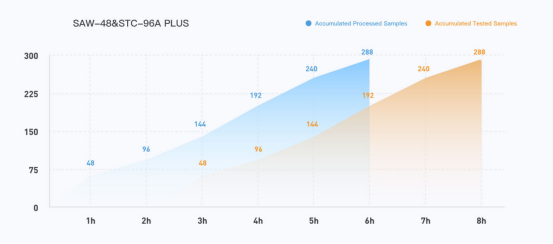
Platform for RT-PCR (288 samples / 8 hours)

Partial enlarged plot of STC-96A PLUS’s temperature curve shows temperature uniformity across 96 wells within 0.05°C.

STC-96A PLUS multitasking software interface (analysis screen)
Within these configurations, our magnetic-bead extraction options cover defined specimen types and automated programs. Our STC-96A PLUS Real-Time PCR System uses two independently controlled 48-well blocks. Final performance depends on the selected assay and local verification.
Explore the Total PCR Solution and related product pages to review the available configurations and specifications. For more product information, contact the BioPerfectus team.
Disclaimer: This article is for general informational and educational purposes only and does not constitute medical, laboratory, regulatory, or other professional advice. For specific product information and application requirements, please refer to official product documentation, applicable regulations, and laboratory SOPs.
