Vaginitis in Focus | Part 3: Integrated assessment
Clinical perspectives from Chinese expert consensus
Precision in vaginitis care depends on interpreting an organism result alongside the patient’s symptoms, the vaginal community and the host response. Chinese expert consensus documents offer a structured way to bring these dimensions together. Their clinical contribution is an integrated assessment framework, supported by laboratory quality standards and condition-specific diagnostic criteria.
Following our discussion of diagnostic uncertainty and aerobic vaginitis (AV), this article examines five complementary Chinese consensus documents published between 2016 and 2026. They address different clinical and laboratory questions; they are not successive editions of one guideline. For international practice, their recommendations should be considered alongside local guidance, validated methods and the population being assessed.
The clinical foundation of integrated assessment
The 2016 clinical application consensus combines morphological assessment with functional testing. Its morphological domains include bacterial density, diversity, dominant flora, microorganisms and disease scores. Functional testing examines metabolites, enzyme activity and pH. The document treats these domains as complementary and gives morphology greater interpretive weight when the two disagree (Cooperative Group of Infectious Disease, Chinese Society of Obstetrics and Gynecology, Chinese Medical Association [CGID], 2016).
For readers familiar with sequencing, microscopic “diversity” here describes distinguishable bacterial morphotypes; it is not a species-level diversity index. Likewise, functional markers supply contextual information rather than a complete etiological diagnosis. The framework encourages clinicians to ask how an observed microorganism fits the wider vaginal picture.
Mixed vaginitis changes the diagnostic question
The 2021 mixed vaginitis consensus focuses on BV, VVC, trichomoniasis and AV. It requires evidence of at least two organisms or fulfillment of multiple disease criteria together with corresponding clinical manifestations requiring treatment. It also advocates individualized, pathogen-directed management and reducing unnecessary antimicrobial exposure (CGID, 2021).
This has two practical implications. A positive finding should not end the investigation when important symptoms remain unexplained. Equally, co-detection should not automatically trigger treatment for every organism. For Candida, the distinction is particularly important: detection without symptoms or signs is not itself an indication for therapy (Centers for Disease Control and Prevention [CDC], 2021c).
How the laboratory consensus documents add clinical value

Figure 1. Complementary roles of five Chinese consensus documents. This is an editorial synthesis, not a formal guideline lineage or a ranking of evidence strength. Sources: CGID (2016, 2021); Hematology and Body Fluid Group (2023); Laboratory Medicine Branch and Laboratory Medicine Committee (2024); Clinical Laboratory Science Committee and Guangdong Branch (2026).
The 2023 automation and reporting consensus addresses the entire testing process, including specimen collection and processing, calibration, performance verification, quality control and reporting. Its clinical significance is that an informative test menu depends on reliable execution. Automation can support efficient workflows, while the consistency of the resulting information still depends on these quality safeguards (Hematology and Body Fluid Group, Chinese Society of Laboratory Medicine [Hematology and Body Fluid Group], 2023).
The 2024 review-rule consensus has a narrower operational purpose: establishing, validating and applying rules for review of automated vaginal secretion results. It gives laboratories a framework for deciding which results require additional assessment. Locally verified review rules are an important part of implementation; an automated output should not be assumed to resolve every diagnostic uncertainty (Laboratory Medicine Branch of Chinese Association of Geriatric Health Medicine Research [Laboratory Medicine Branch] & Laboratory Medicine Committee of Shanghai Scientific Association of Better Birth and Better Upbringing (Shanghai Maternal and Child Health Association) [Laboratory Medicine Committee], 2024).
The 2026 standardization consensus brings specimen handling, quality control, morphological and chemical examinations, reporting and clinical application into one laboratory framework. It includes community descriptors and condition-related scoring approaches. Its practical contribution is a shared structure for communicating findings across clinical and laboratory teams (Clinical Laboratory Science and Technology Transformation Professional Committee of the China Association for Promotion of Health Science and Technology [Clinical Laboratory Science Committee] & Branch of Clinical Laboratory Physicians of the Guangdong Medical Doctor Association [Guangdong Branch], 2026).
Together, these documents connect clinical interpretation with laboratory governance. The clinical documents explain why multiple dimensions matter; the laboratory documents address how those dimensions can be measured, checked and reported consistently. Their value is complementary, and their scope should remain visible when translating recommendations into practice.
Four conditions require distinct diagnostic reasoning
Integrated assessment preserves the differences among bacterial vaginosis (BV), vulvovaginal candidiasis (VVC), trichomoniasis (TV) and AV. A result panel becomes clinically useful when each finding is linked to the appropriate diagnostic question and the limitations of the method.
| Condition |
Diagnostic focus |
What integrated assessment adds |
| BV |
Community pattern assessed through established criteria, such as Nugent scoring or Amsel criteria. |
Places clue cells and altered flora in context. A raised pH alone does not establish BV. |
| VVC |
Compatible symptoms and signs plus yeast evidence by microscopy, culture or an appropriate validated test. |
Helps distinguish symptomatic disease from colonization and identifies when further fungal testing is appropriate. |
| TV |
Specific evidence of T. vaginalis infection. A negative wet mount does not reliably exclude infection. |
Supports escalation to a more sensitive molecular test when indicated and connects diagnosis with STI management. |
| AV |
Clinical findings integrated with microscopy of lactobacilli, inflammatory cells, background flora and epithelial changes. |
Retains evidence of host response and epithelial status that organism detection alone cannot supply. |
Table 1. Clinical interpretation across four common conditions. Sources: CGID (2016, 2021); CDC (2021a, 2021b, 2021c).
For suspected TV, method selection is decisive. CDC guidance reports wet-mount sensitivity of approximately 44%–68% compared with culture, with sensitivity falling rapidly after collection. Molecular assays offer greater sensitivity. A morphology-centered assessment therefore needs access to appropriate additional testing; negative microscopy should not close the TV pathway (CDC, 2021b).
For symptomatic patients with a negative yeast wet mount, CDC recommends considering Candida culture. Complicated or recurrent presentations may require species identification and further investigation. A normal pH does not exclude VVC (CDC, 2021c).
For AV, inflammation and epithelial findings are central to interpretation. A report limited to an aerobic organism may miss the syndrome’s defining clinical context. Laboratories should name the AV scoring method used, because different microscopy approaches and modified scores are not automatically interchangeable (CGID, 2016; Clinical Laboratory Science Committee & Guangdong Branch, 2026).
These distinctions also clarify the role of biochemical markers. pH and enzyme activity can support interpretation, but their specificity and performance depend on the analyte and assay. They should not be treated as interchangeable substitutes for condition-specific diagnostic evidence.
Why comprehensive evaluation is an advanced diagnostic approach
We regard integrated evaluation as a clinically advanced approach because it organizes several relevant forms of evidence around one decision: what best explains this patient’s presentation, and what action is justified? This is an assessment of the framework’s clinical design, rather than a claim of proven superiority for a particular instrument or product.
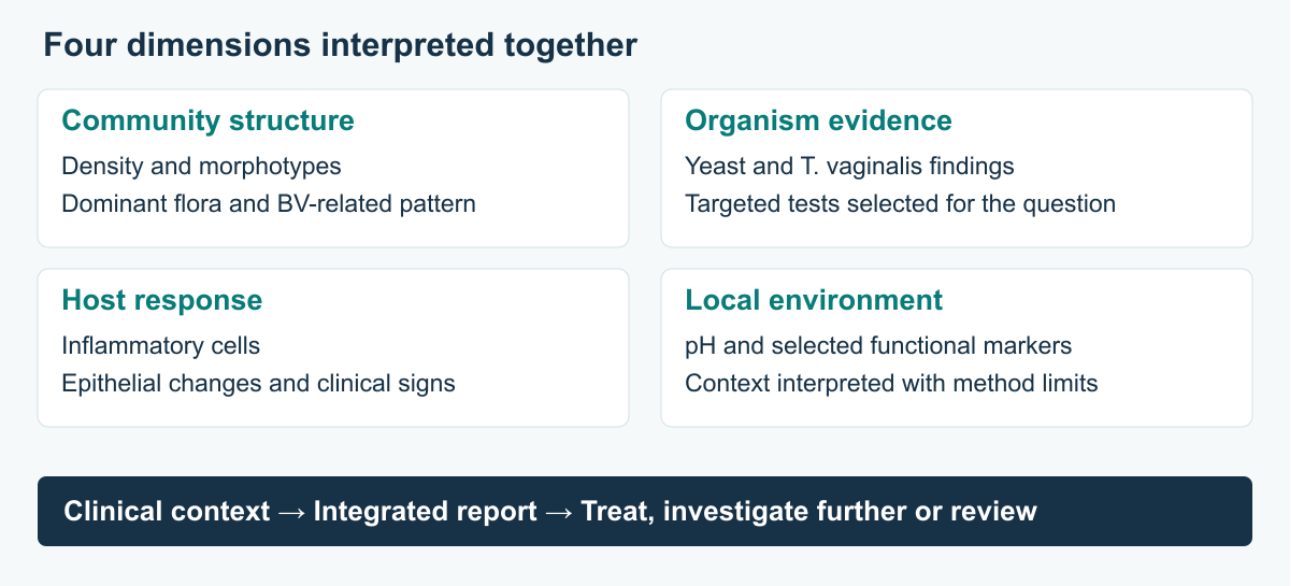
Figure 2. An integrated interpretation pathway. Original clinical synthesis informed by CGID (2016, 2021), the laboratory consensus documents (2023–2026) and CDC (2021a–c). The dimensions are complementary; additional testing follows the clinical question and method limitations.
Its first strength is interpretive completeness. Community structure, pathogen evidence and host response can explain different parts of the same presentation. Its second is disciplined follow-through: a discordant result can prompt review, repeat sampling or a targeted additional test. Its third is communication: a structured report can make the evidence and the remaining uncertainty easier to discuss with the treating clinician.
Consider a patient with persistent discharge, elevated pH and marked inflammation after treatment for presumed BV. An integrated review would revisit BV criteria, assess AV-related microscopic changes and consider TV testing according to the initial method and clinical risk. It would also revisit sampling, prior medication and alternative causes. This illustrative scenario shows how assessment can guide the next diagnostic step; it does not prescribe a universal treatment sequence.
Persistent inflammation without an identified vaginal pathogen also warrants consideration of cervicitis or noninfectious causes and, when appropriate, specialist evaluation. CDC guidance emphasizes that history alone is insufficient and supports examination plus laboratory testing to establish the cause of symptoms (CDC, 2021a).
From a richer report to a better clinical decision
The strongest case for overall vaginal microecology evaluation is its ability to support a coherent, quality-controlled interpretation. Its implementation should preserve sensitive pathogen testing, distinguish colonization from symptomatic disease and make review pathways explicit. Prospective studies are still needed to quantify whether a specific integrated workflow improves prescribing, symptom resolution, recurrence or costs compared with existing care.
For our approach, the priority is clear: deliver results that help clinicians justify treatment, select the next investigation and recognize when a diagnosis needs reconsideration. Part 4 will examine how the BioPerfectus diagnostic portfolio can address these workflow needs using verified product-specific information.
References
Centers for Disease Control and Prevention. (2021a). Diseases characterized by vulvovaginal itching, burning, irritation, odor or discharge. In Sexually transmitted infections treatment guidelines, 2021. https://www.cdc.gov/std/treatment-guidelines/vaginal-discharge.htm
Centers for Disease Control and Prevention. (2021b). Trichomoniasis. In Sexually transmitted infections treatment guidelines, 2021. https://www.cdc.gov/std/treatment-guidelines/trichomoniasis.htm
Centers for Disease Control and Prevention. (2021c). Vulvovaginal candidiasis. In Sexually transmitted infections treatment guidelines, 2021. https://www.cdc.gov/std/treatment-guidelines/candidiasis.htm
Clinical Laboratory Science and Technology Transformation Professional Committee of the China Association for Promotion of Health Science and Technology, & Branch of Clinical Laboratory Physicians of the Guangdong Medical Doctor Association. (2026). 阴道微生态评价临床检验与结果报告规范化专家共识 [Expert consensus on the standardization of clinical laboratory evaluation and reporting of vaginal microecology]. Chinese Journal of Clinical Laboratory Management (Electronic Edition), 14(1), 12–20. https://doi.org/10.3877/cma.j.issn.2095-5820.2026.01.004
Cooperative Group of Infectious Disease, Chinese Society of Obstetrics and Gynecology, Chinese Medical Association. (2016). 阴道微生态评价的临床应用专家共识 [Expert consensus on the clinical application of vaginal microecological evaluation]. Chinese Journal of Obstetrics and Gynecology, 51(10), 721–723. https://doi.org/10.3760/cma.j.issn.0529-567X.2016.10.001
Cooperative Group of Infectious Disease, Chinese Society of Obstetrics and Gynecology, Chinese Medical Association. (2021). 混合性阴道炎诊治专家共识(2021版) [Expert consensus on the diagnosis and treatment of mixed vaginitis (2021 edition)]. Chinese Journal of Obstetrics and Gynecology, 56(1), 15–18. https://doi.org/10.3760/cma.j.cn112141-20200603-00472
Hematology and Body Fluid Group, Chinese Society of Laboratory Medicine. (2023). 阴道分泌物自动化检测与报告专家共识 [Expert consensus on automatic detection and report of vaginal secretions]. Chinese Journal of Laboratory Medicine, 46(5), 439–444. https://doi.org/10.3760/cma.j.cn114452-20221207-00723
Laboratory Medicine Branch of Chinese Association of Geriatric Health Medicine Research, & Laboratory Medicine Committee of Shanghai Scientific Association of Better Birth and Better Upbringing (Shanghai Maternal and Child Health Association). (2024). 自动化阴道分泌物分析系统复检规则的建立与验证专家共识 [Expert consensus on establishment and validation of review rules for automatic vaginal secretion analysis system]. Laboratory Medicine, 39(5), 415–422. https://doi.org/10.3969/j.issn.1673-8640.2024.05.001
