A 2026 review highlights the BioPerfectus BMRT workflow as an example of combining HPV genotype information with viral load corrected for sample cellularity.
More informative results after HPV detection
A positive HPV result identifies an infection, but understanding its significance requires context. Most infections resolve, while persistent infection with a high-risk genotype can lead to cervical precancer and cancer. For laboratories and screening programs, an important question is how molecular testing can provide additional information about these different infection patterns. [1]
A review published in Expert Review of Molecular Diagnostics in May 2026 examines HPV viral load as a potential biomarker of persistence, cervical disease and clinical outcomes. The authors specifically use the BioPerfectus Multiplex Real-Time PCR (BMRT) workflow to illustrate cell-normalized HPV quantification. Their discussion connects a practical laboratory challenge, variation in sample cellularity, with a distinctive feature of BioPerfectus HPV testing. [1, pp. 507–509]
Genotype information gives viral load its context
HPV genotypes differ in their association with cervical disease, and the relationship between viral load and lesion severity also varies by type. The review finds the most consistent evidence for HPV16; findings for HPV18 and several other types are less uniform. A quantitative result therefore becomes more informative when the genotype being measured is known. [1]
The BioPerfectus Human Papillomavirus Genotyping Real Time PCR Kit individually identifies 21 HPV genotypes. This level of resolution distinguishes specific types within a positive sample and supports comparison of genotype results across visits. In the BMRT quantitative workflow described in the literature, genotype information is combined with measurement of viral burden. This allows researchers to examine type-specific patterns, including in samples containing multiple HPV genotypes. [1,2]
Repeated detection of the same genotype is relevant to persistence assessment, although it cannot by itself distinguish continuous infection from reinfection. Likewise, detecting more types does not mean that every genotype has the same clinical risk or belongs in an identical management pathway. [1]
Cell normalization makes the quantity more interpretable
Cervical specimens can contain very different numbers of human cells. Collection technique, the sampled area and the amount of material recovered can all influence the DNA entering an assay. Reporting viral copies without accounting for cellular input can therefore make comparisons difficult. [1]
Consider two hypothetical samples, each containing 20,000 HPV copies in the analyzed material. If sample A contains 10,000 human cells, its normalized load is 20,000 copies per 10,000 cells. If sample B contains 100,000 human cells, its normalized load is 2,000 copies per 10,000 cells. The raw viral copy count is identical, but the cell-normalized values differ tenfold. This calculation illustrates the measurement principle; it is not a clinical risk threshold.
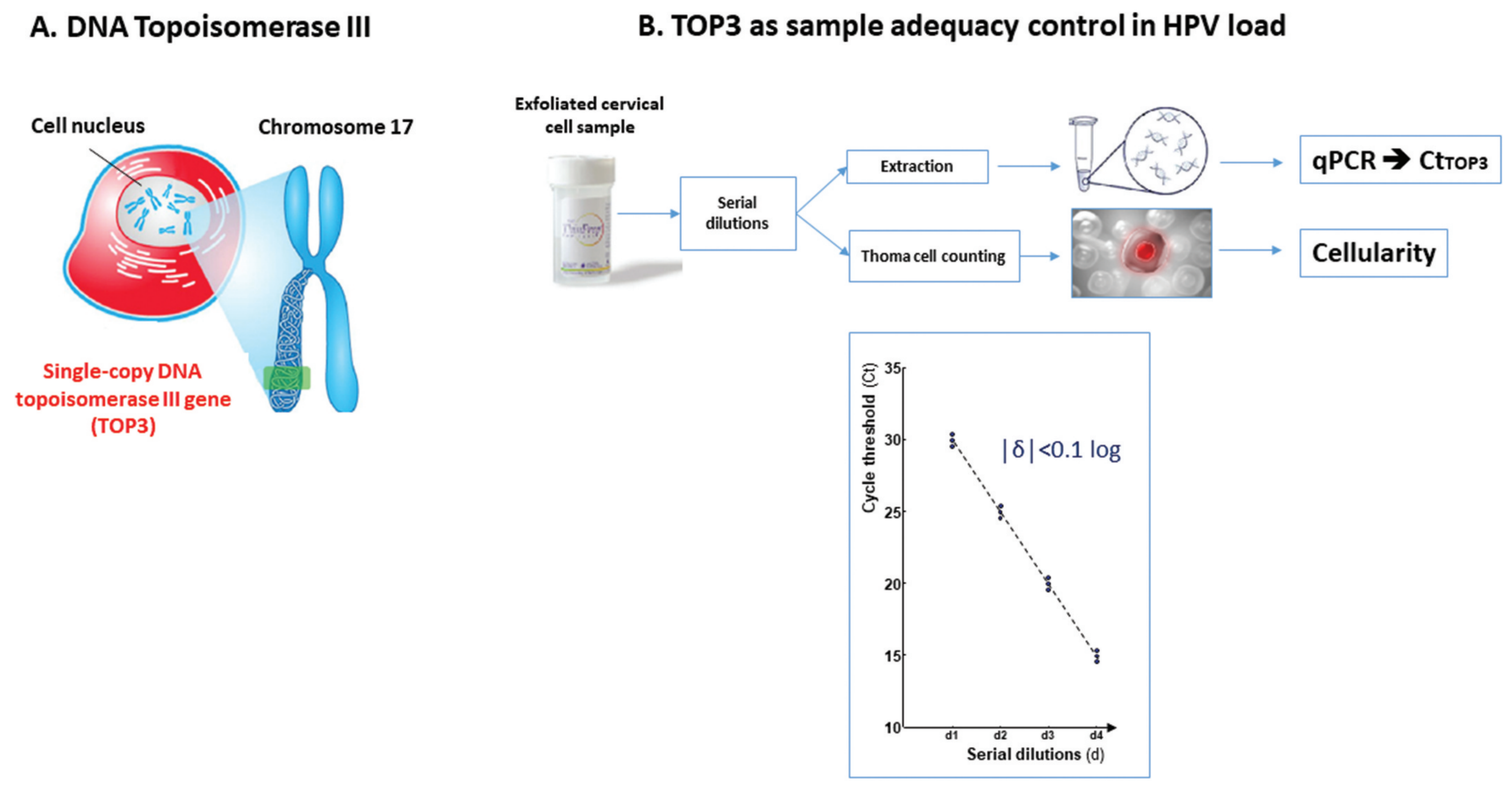
Figure 1. Diagram of DNA Topoisomerase III gene and its use in HPV load control with qPCR and cellularity assessment in the BioPerfectus Multiplex Real Time (BMRT) Human Papillomavirus Genotyping Real Time PCR Kit (Jiangsu BioPerfectus Technologies Co., Ltd., China), as an example. Reproduced from [1], Figure 2.
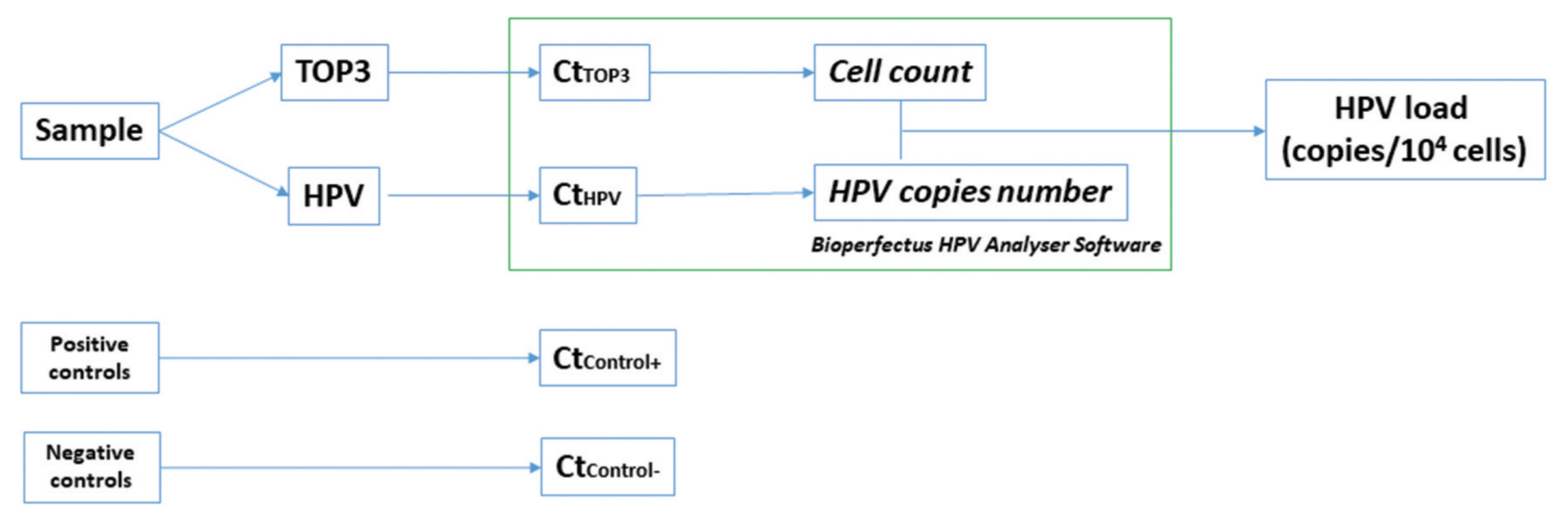
Figure 2. Standardized HPV viral load quantification using the BioPerfectus BMRT HPV Genotyping Real-Time PCR Kit. Each clinical sample is simultaneously tested for HPV DNA and the human single-copy gene TOP3. The cycle threshold values for HPV and TOP3 are analyzed by BioPerfectus HPV Analyser Software to calculate HPV copy number and human cell count, respectively. Positive and negative controls are included to verify amplification performance and assay reliability. The resulting HPV viral load is normalized to the cellular content of the sample and reported as HPV copies per 10,000 human cells or as log10-transformed copies per 10,000 cells. This approach supports accurate, reproducible, and comparable viral load measurement across samples by accounting for differences in sample cellularity and collection efficiency. Reproduced from [1], Figure 3.
The BMRT approach illustrated in Figures 1–2 addresses this issue by relating HPV DNA quantity to an estimate of human cell number. Reporting copies per 10,000 cells, or the corresponding log10 value, makes the denominator explicit. An uncalibrated Ct value alone does not provide this cell-normalized measurement. Normalization reduces the influence of differences in cellular input, while consistent sampling, extraction and calibration remain necessary. [1]
TOP3 provides a reference for cellular input
In the published BMRT workflow, the human single-copy TOP3 gene provides the molecular reference for estimating cellular input. HPV target measurements and TOP3 measurements are analyzed within the quantitative workflow, and BioPerfectus HPV Analyser Software calculates viral copy number and estimated human cell count to produce a normalized result. [1]
As shown in Figure 1, the cited review describes an assay verification exercise comparing TOP3-based cell estimates with microscopy-based counting across serial dilutions of cervical cell samples. The authors report a difference below 0.1 log under those verification conditions. This example supports the molecular cell-counting principle used for normalization in the BMRT workflow. [1, p. 508]
A human reference signal also contributes information about specimen adequacy. Importantly, an internal control used only to confirm a valid test is not automatically equivalent to a calibrated, quantitative cell reference. The relevant BioPerfectus feature is the use of that cellular reference in the calculation of HPV burden. [1], [2]
Published studies connect the workflow with clinical questions
The review draws on studies that used BMRT to investigate the relationship between type-specific load and cervical lesions. In a nested case-control study by Dong and colleagues, 1,396 high-risk HPV-positive specimens were selected from a screening cohort of 19,446 women. HPV16, HPV31, HPV33, HPV52 and HPV58 loads were positively associated with lesion severity; the same relationship was not observed for every genotype. [1], [4]
For HPV16, a study-derived threshold of 4.26 log10 copies per 10,000 cells identified high-grade squamous intraepithelial lesion or worse with 79% sensitivity and 81% specificity. These results demonstrate a research application of BMRT-generated quantitative data. The estimates apply to that selected study population, and the threshold requires further validation before application in other settings. [4]
A separate analysis using physician-collected samples from the Chinese Multi-Center Screening Trial investigated BMRT viral load combined with genotyping as a secondary screening strategy. Together, these studies provide a published basis for further evaluation of genotype-specific, normalized measurements in defined populations and protocols. [1], [5]
Serial measurements can support research into infection dynamics
The review also considers viral load changes over time and associations with clearance, persistence and post-treatment findings. Using the same genotype-specific, cell-normalized measurement approach across visits can help researchers study these trajectories with a consistent reporting unit. [1]
Interpretation nevertheless requires care. A high load can reflect productive infection, while viral integration and changes in replication may produce lower DNA quantities despite important disease. Falling load alone therefore cannot establish clearance, treatment success or absence of a lesion. Genotype, sampling quality and clinical findings remain essential context. [1]
Connecting genotype identity with a defined quantitative result
The value of the published BMRT approach lies in bringing complementary measurements together. Genotyping identifies which HPV type is detected. The cellular reference provides information about the amount of human material analyzed. Normalized viral load expresses the quantity of that HPV type relative to the estimated cell count. Read together, these outputs describe the sample more fully than an unnormalized viral copy count alone. [1]
For research partners, this structure supports clearly specified questions: whether a particular genotype remains detectable, how its normalized load changes between visits, and whether those patterns are associated with defined clinical endpoints. Using an explicit denominator also makes methods and reporting easier to describe when comparing results within a study. This is a practical contribution to building interpretable HPV datasets, with cross-laboratory comparisons still requiring assay harmonization. [1]
A workflow designed for molecular laboratories
Alongside the quantitative workflow discussed in the literature, BioPerfectus lists individual 21-genotype reporting, compatibility with cervical specimens including ThinPrep and BD SurePath samples, and use with mainstream real-time PCR instruments. These features offer laboratories practical options for incorporating detailed genotyping into established molecular testing processes. [3]
Implementation should match the selected assay configuration to the intended specimen, extraction method, instrument and software. For quantitative studies, consistent calibration and quality control help laboratories maintain the measurement conditions needed for reliable comparisons. Genotyping and quantitative reporting should each follow the requirements of the selected workflow. [1], [3]
Building the evidence for quantitative HPV testing
The 2026 review presents HPV viral load as a promising but investigational biomarker, with no internationally standardized clinical cutoffs. Its possible role in triage requires further prospective validation, reproducibility assessment and evidence of clinical benefit. A viral load result should not independently determine referral, treatment or screening intervals. [1]
BioPerfectus contributes a concrete measurement approach to this work: individual genotype identification combined, in the published BMRT quantitative workflow, with TOP3-based correction for cellular input. This provides laboratories and research partners with a way to study HPV burden in a defined biological context and to develop evidence for future applications. [1], [2]
Contact BioPerfectus to discuss HPV genotyping, the published BMRT quantitative workflow and configurations available for your laboratory. Product availability, reportable outputs and intended use depend on the locally registered version. Quantitative applications must follow the applicable instructions for use and validated protocol.
References
[1] Mboumba Bouassa RS, Muwonga Tukisadila J, Loemba H, Bélec L. Human papillomavirus viral load as promising surrogate biomarker of cervical cancer risk and clinical outcome. Expert Review of Molecular Diagnostics. 2026;26(6):501-522. Published online 31 May 2026. https://doi.org/10.1080/14737159.2026.2675388
[2] Sun Z, Zhang R, Liu Z, et al. Development of a fluorescence-based multiplex genotyping method for simultaneous determination of human papillomavirus infections and viral loads. BMC Cancer. 2015;15:860. https://doi.org/10.1186/s12885-015-1874-9
[3] BioPerfectus. Human Papillomavirus Genotyping Real Time PCR Kit. Official product information. Accessed 26 October 2026. https://www.bioperfectus.com/productdetail/humanpapillomavirusgenotypingrealtimepcrkit
[4] Dong B, Sun P, Ruan G, et al. Type-specific high-risk human papillomavirus viral load as a viable triage indicator for high-grade squamous intraepithelial lesion: a nested case-control study. Cancer Management and Research. 2018;10:4839-4851. https://doi.org/10.2147/CMAR.S179724
[5] Duan L, Du H, Wang C, et al. The application of BMRT-HPV viral load to secondary screening strategies for cervical cancer. PLOS ONE. 2020;15(5):e0232117. https://doi.org/10.1371/journal.pone.0232117
