Key takeaways
Zika virus (ZIKV), dengue virus (DENV), and chikungunya virus (CHIKV) can circulate during the same mosquito season and cause overlapping fever, rash, and joint symptoms. For acute, clinically unresolved cases, a multiplex real-time reverse transcription polymerase chain reaction (rRT-PCR) test can detect and differentiate all three viral RNA targets in one workflow. The most suitable assay depends on illness timing, specimen coverage, regional strain inclusivity, clinical performance, internal controls, instrument compatibility, regulatory status, and laboratory volume. Singleplex PCR and rapid tests remain useful in defined scenarios.
Why does Simultaneous Zika, Dengue, and Chikungunya Testing Matter?
Clinical findings can guide triage, but they do not reliably identify which arbovirus caused an acute infection. The three viruses share Aedes mosquito vectors, overlapping geographic distributions, and several early clinical manifestations.
WHO reported more than 14.6 million dengue cases and over 12,000 dengue-related deaths in 2024. At the same time, Zika transmission persists at lower levels in parts of the Americas, Asia, and Africa, while chikungunya continues to cause outbreaks and imported cases (WHO, 2025).
| Virus |
Findings that May Support Suspicion |
Important Clinical Concern |
Main Molecular Testing Period |
| ZIKV |
Rash, pruritus, conjunctivitis |
Pregnancy-related congenital abnormalities and neurologic complications |
For symptomatic nonpregnant patients with relevant exposure, serum NAAT is generally used within 7 days of symptom onset |
| DENV |
High fever, leukopenia, thrombocytopenia, rising hematocrit |
Plasma leakage, severe bleeding, shock, or organ impairment |
NAAT or NS1 testing during days 0–7 |
| CHIKV |
Abrupt fever and prominent polyarthralgia |
Persistent joint symptoms and occasional neurologic or cardiac complications |
RT-PCR on blood collected during the first week |
These time frames come from current CDC dengue guidance, CDC Zika guidance, and the WHO chikungunya fact sheet. Pregnancy, outbreak surveillance, and national reporting programs may require different specimen and testing algorithms.
Which Multiplex PCR Strategy Fits Seasonal Outbreaks across Endemic Regions?
A validated Zika/Dengue/Chikungunya triplex RT-PCR is generally appropriate when all three pathogens are epidemiologically plausible and patients present during the acute phase. It can produce three target-specific results from one extraction and amplification workflow.
However, regional epidemiology should determine whether a focused triplex assay is sufficient or whether additional pathogens require parallel or reflex testing.
1. Southeast Asia
During the rainy season, laboratories may experience a sharp increase in dengue testing volume while still needing to investigate Zika and chikungunya. A multiplex PCR test may reduce sequential testing when fever, rash, arthralgia, and travel history do not support one clear diagnosis.
In this setting, laboratories should verify coverage of DENV-1 through DENV-4 and relevant circulating CHIKV and ZIKV lineages. Throughput, reagent stability, and compatibility with existing extraction and real-time PCR systems are also important during seasonal demand peaks.
2. Africa
In parts of Africa, DENV, CHIKV, ZIKV, yellow fever virus, malaria, and other causes of acute febrile illness may overlap. A three-target assay can support focused arbovirus differentiation, although it cannot identify pathogens outside its target panel.
Laboratories should therefore assess whether the ZIKV/DENV/CHIKV triplex will serve as the primary test, a first-tier screen followed by reflex testing, or one component of a broader febrile illness algorithm.
3. Latin America and Brazil
The same selection framework applies in Latin America, where co-circulation can make symptom-based differentiation difficult. A Brazilian hospital receiving patients with fever, rash, and joint pain may reasonably prioritize a clinical-use triplex assay when the objective is to distinguish ZIKV, DENV, and CHIKV from one supported specimen.
For this application, serum or EDTA whole blood may be practical acute-phase specimens when included in the manufacturer’s intended use. The hospital should also evaluate specimen input, internal controls, extraction capacity, PCR throughput, result interpretation, and local regulatory requirements.
Triplex RT-PCR vs. Singleplex PCR: Which Fits Each Scenario?
Triplex RT-PCR is generally favored when the pretest probabilities of Zika, dengue, and chikungunya overlap. Singleplex PCR remains practical when one pathogen is strongly suspected or when a specialized reflex assay is required.
| Decision Factor |
Triplex RT-PCR |
Singleplex PCR |
| Epidemiologic fit |
Co-circulation, outbreaks, travel-associated illness, or nonspecific symptoms |
Strong suspicion of one pathogen or targeted confirmatory testing |
| Workflow |
Simultaneous results from one reaction workflow |
Separate or sequential reactions |
| Turnaround time |
May reduce delays caused by ordering additional tests after an initial negative result |
Efficient when only one target is required |
| Cost considerations |
May reduce duplicated extraction, controls, reagents, and labor when all three results are needed |
May use fewer reagents when only one pathogen is clinically relevant |
| Result interpretation |
Supports three-way differentiation and possible coinfection detection |
Provides simpler target-specific interpretation |
| Additional information |
Usually reports DENV detection without serotype differentiation unless specifically designed otherwise |
A dedicated assay may provide DENV serotyping or another specialized result |
Actual cost per reportable result depends on batch size, positivity rate, repeat testing, controls, labor, instrument utilization, and local reagent pricing.
Multiplex PCR, Singleplex PCR, or Rapid Tests: How should Laboratories Choose?
The testing method should follow the illness stage and diagnostic question. During the acute phase, multiplex molecular testing can support three-way differentiation when all targets are plausible.
For dengue diagnosis, the CDC recommends testing serum samples during the first 7 days after symptom onset using either a nucleic acid amplification test (NAAT) combined with an IgM antibody test or an NS1 antigen test combined with an IgM antibody test. Beyond day 7 after symptom onset, IgM antibody testing is recommended as the primary diagnostic approach, although NAAT or NS1 antigen testing may still yield positive results in some patients.
For chikungunya, WHO recommends direct molecular detection during the first week and antibody testing after the first week. For Zika, molecular testing is particularly relevant because ZIKV and DENV antibody results may cross-react.
Validated rapid tests can support triage where molecular capacity is limited. However, a dengue NS1 or antibody test does not simultaneously exclude ZIKV or CHIKV. Rapid testing alone may therefore leave the central three-pathogen differential diagnosis unresolved.
A practical testing pathway is:
| Clinical and Laboratory Scenario |
Testing Approach to Consider |
| Acute illness with unclear arbovirus diagnosis |
ZIKV/DENV/CHIKV multiplex rRT-PCR |
| Strong suspicion of one pathogen |
Targeted singleplex PCR |
| Dengue-focused acute testing |
DENV NAAT plus IgM, or NS1 antigen testing plus IgM |
| Presentation after the main RNA-detection window |
Pathogen-appropriate serology and local diagnostic algorithm |
| Broader unexplained tropical fever |
Wider pathogen panel or reflex testing based on epidemiology |
What Defines the Best Multiplex PCR Test?
The best multiplex PCR test is the assay that fits the laboratory’s clinical, epidemiologic, operational, and regulatory requirements. Analytical sensitivity should be assessed alongside clinical evidence and workflow suitability.
Key procurement criteria include:
- Intended use and regulatory status in the destination market.
- DENV-1 to DENV-4 coverage and relevant ZIKV and CHIKV lineages.
- Supported specimen types for each viral target.
- Target-specific limit of detection and the units used to report it.
- Clinical sensitivity, specificity, and target-specific sample sizes.
- Cross-reactivity and coinfection evaluation.
- Extraction, amplification, and inhibition controls.
- Instrument channels, throughput, hands-on time, and extraction compatibility.
- Storage, transport, and external quality-control requirements.
- Clear interpretation rules for positive, negative, and invalid results.
A negative molecular result should be interpreted in relation to symptom onset, specimen quality, viral load, and internal-control performance. It does not independently exclude infection when collection occurs outside the validated molecular detection period.
Where does the BioPerfectus Multiplex PCR Test Fit?
The BioPerfectus Zika Virus/Dengue Virus/Chikungunya Virus Real Time PCR Kit is a CE-IVD multiplex assay designed for qualitative detection of ZIKV, DENV, and CHIKV RNA in one molecular workflow. It includes an internal process control and has a limit of detection of 5 copies per reaction.
Serum, EDTA whole blood, and cerebrospinal fluid can be used for all three targets, while urine and amniotic fluid are intended specifically for ZIKV RNA detection. The assay uses a 5 µL sample input and supports a 79-minute, 96-test workflow on compatible real-time PCR instruments.
These features make the kit an option for hospital, reference, and public health laboratories seeking focused ZIKV/DENV/CHIKV differentiation during seasonal surges or regional outbreaks.
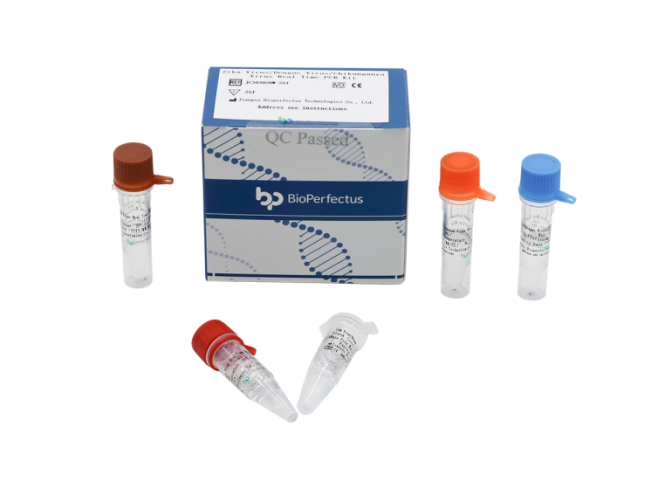
Zika Virus / Dengue Virus / Chikungunya Virus Real Time PCR Kit
Conclusion
A ZIKV/DENV/CHIKV multiplex rRT-PCR assay can support acute arbovirus differentiation when symptoms and epidemiology do not indicate one likely pathogen. The strongest use cases include mosquito-borne disease seasons, co-endemic regions, travel-associated cases, and hospitals seeking three target-specific results from one supported specimen. Singleplex PCR, dengue NS1, serology, and broader fever panels remain appropriate at other illness stages or for different diagnostic questions. Laboratories should compare target inclusivity, specimen coverage, controls, clinical evidence, throughput, regulatory status, and total workflow requirements.
BioPerfectus provides one focused triplex solution that can be assessed within this evidence-based procurement framework.
