Accurate dengue diagnosis depends not only on which test is used but also on when the patient is tested. NS1 antigen testing and reverse transcription-polymerase chain reaction (RT-PCR) can both detect dengue during the acute phase, yet they identify different viral markers and have distinct operational requirements. As infection progresses, antibody testing becomes increasingly relevant. Understanding how NS1, RT-PCR, and IgM/IgG tests complement one another helps healthcare professionals select appropriate diagnostic strategies rather than relying on a single method throughout the illness.
What Is a Dengue NS1 Antigen Test?
A dengue NS1 antigen test detects nonstructural protein 1 (NS1), a viral protein released into the bloodstream during dengue infection. Because NS1 can be present before detectable antibodies develop, it serves as an important marker of acute infection.
According to the Centers for Disease Control and Prevention (CDC), NS1 is generally detectable during the first seven days after symptom onset. A positive result provides evidence of current or recent dengue infection, although a negative result does not exclude it.[3]
NS1 testing is available in different formats, including laboratory-based immunoassays and rapid diagnostic tests. A rapid dengue NS1 antigen test can offer several practical advantages:
- Early detection: Identifies viral antigen before antibody responses become reliably detectable.
- Simplified workflow: Rapid formats may operate without specialized laboratory instrumentation.
- Timely results: Supports clinical assessment where molecular testing is less accessible.
However, NS1 detection varies with infection timing, viral serotype, and whether the patient has previously had dengue. These factors make result interpretation particularly important.
What Is RT-PCR Testing for Dengue?
RT-PCR is a molecular diagnostic method that identifies dengue virus RNA in patient samples. It converts viral RNA into complementary DNA before amplifying specific genetic sequences, allowing laboratories to detect evidence of active viral infection.
RT-PCR is particularly valuable during the acute phase, when viral RNA is usually detectable in the first seven days after symptoms begin. Many molecular assays can also identify the infecting dengue virus serotype, providing information useful for epidemiological surveillance.
Key characteristics of RT-PCR include:
- Direct viral detection: Identifies dengue RNA rather than the body's antibody response.
- Molecular specificity: Uses targeted genetic sequences to detect dengue virus.
- Laboratory requirements: Typically requires specialized equipment, trained personnel, and appropriate sample-processing procedures.
Despite its diagnostic value, RT-PCR has limitations. Viral RNA levels generally decline as infection progresses, potentially producing negative results in later samples.
Consequently, RT-PCR should be interpreted alongside symptom duration and clinical findings rather than treated as a universally definitive test at every stage of infection.
Dengue NS1 Antigen Test vs RT-PCR: What Are the Key Differences?
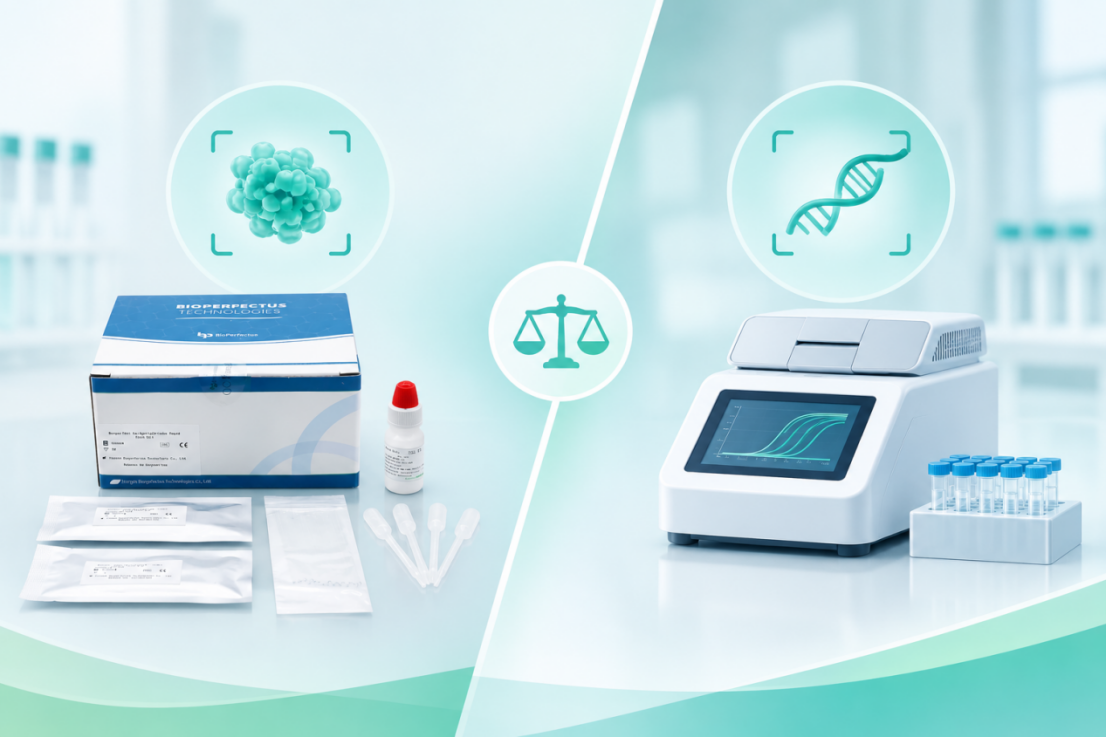
The main difference between NS1 antigen testing and RT-PCR lies in what they detect and how testing is performed. Both are useful during acute dengue infection, but their operational characteristics influence when each approach is appropriate.
| Comparison |
NS1 Antigen Test |
RT-PCR |
| Detection target |
Dengue NS1 protein |
Dengue viral RNA |
| Primary testing window |
First 0–7 days |
First 0–7 days |
| Technology |
Immunoassay |
Molecular amplification |
| Result turnaround |
Often minutes with rapid formats |
Depends on laboratory workflow |
| Equipment |
Rapid formats may require none |
Specialized equipment required |
| Serotype identification |
Not generally provided |
Possible with suitable assays |
| Main limitation |
Variable antigen detectability |
Declining RNA levels over time |
Importantly, neither method is consistently superior under every clinical condition.
A 2025 study by Liu et al., published in the Journal of Infection and Public Health, compared two NS1 rapid diagnostic tests against RT-PCR. The researchers found that NS1 test sensitivity varied with sampling time and infection characteristics, while combining NS1 detection with IgM serology improved diagnostic sensitivity.[4]
These findings reinforce a practical principle: test performance depends on clinical context, not simply the underlying technology. For early dengue evaluation, clinicians should therefore consider both diagnostic availability and the patient's stage of illness.
How to Choose the Right Dengue Test Based on Infection Stage?
The most appropriate dengue testing strategy changes as viral markers and antibodies become detectable at different times. The CDC recommends combining nucleic acid amplification testing or NS1 antigen testing with IgM testing during the first seven days of illness.[3]
1. Early Acute Phase (Days 0–3)
During the earliest symptomatic period, RT-PCR and NS1 antigen testing are valuable because viral RNA and NS1 protein may already be detectable.
IgM antibodies, however, may not yet have developed sufficiently for reliable detection.
For patients presenting during this period:
- Consider RT-PCR together with IgM antibody testing when molecular testing is available and clinically appropriate.
- Consider NS1 antigen testing together with IgM antibody testing, particularly when rapid assessment is needed.
- Do not exclude dengue solely because an initial test is negative.
Early diagnostic results must be interpreted alongside symptoms, exposure history, and clinical risk. When dengue is suspected, appropriate clinical management should not be delayed while awaiting laboratory confirmation.
2. Late Acute Phase (Days 4–7)
During days four through seven, the detection windows for NS1 antigen, viral RNA, and IgM antibodies may overlap as antibody responses develop.
IgM antibodies generally become detectable after the first several days of illness, adding diagnostic value as viral markers begin to decline.
Combining antigen or molecular testing with IgM assessment can therefore improve the likelihood of identifying infections that one method might miss.
For example, a patient with negative NS1 results may still have detectable IgM antibodies. Conversely, a positive NS1 or RT-PCR result may help identify acute infection before a measurable antibody response develops.
3. Convalescent Phase (After Day 7)
After the first week, IgM antibody testing generally becomes the primary diagnostic approach, although some patients may still have detectable viral RNA or NS1 antigen.
IgG requires more cautious interpretation. A positive IgG result in a single sample may reflect previous dengue infection or exposure to related flaviviruses rather than a current infection.
Healthcare professionals should therefore consider:
- IgM results: A positive result in a single sample supports a presumptive recent dengue infection, but cross-reactivity with other flaviviruses must be considered.
- IgG results: A single positive IgG result cannot confirm acute dengue infection and should be interpreted alongside infection history and other laboratory findings.
- Follow-up samples: Additional testing when initial results remain inconclusive.
How Does BioPerfectus Support Dengue Testing Across Infection Stages?
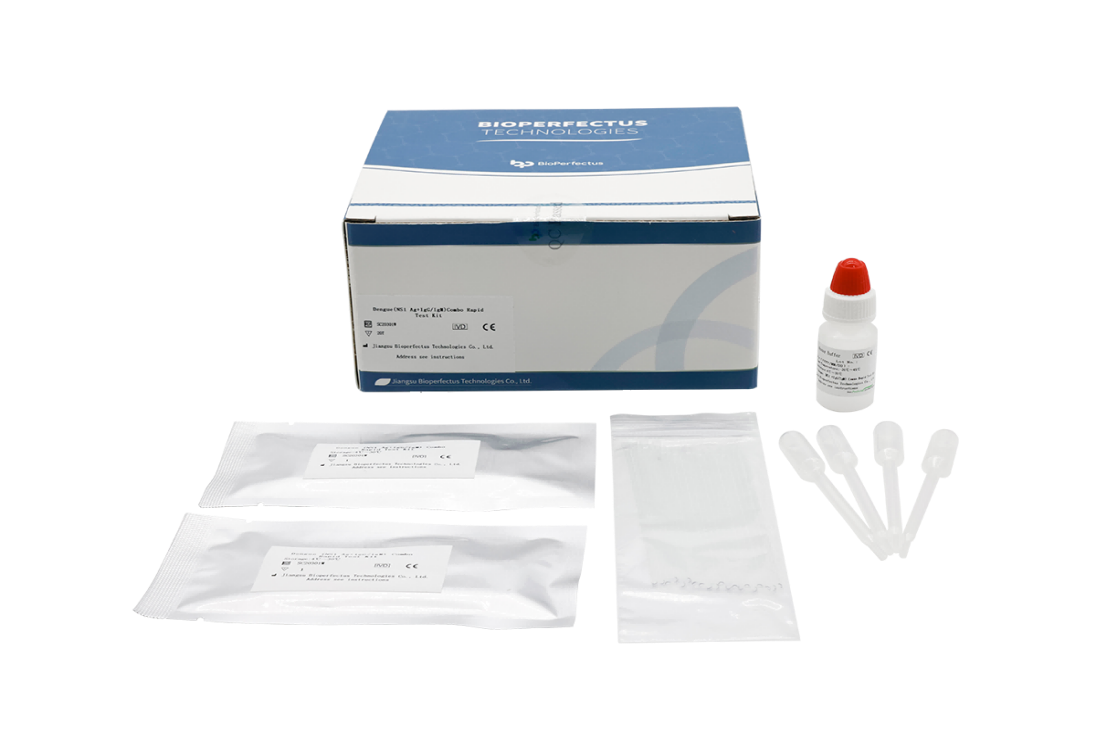
BioPerfectus offers the Dengue (NS1 Ag+IgG/IgM) DUO Rapid Test Kit, which combines antigen and antibody detection in a single rapid testing format. Designed for professional use with human serum or plasma, the kit supports dengue diagnostic assessment from the acute phase through convalescence.[1,2]
The dengue test kit offers several key advantages:
- Combined antigen and antibody detection: Detects NS1 antigen alongside IgM and IgG antibodies, providing information from multiple markers relevant to different infection stages.
- Rapid results: Delivers results within 15 minutes, supporting timely diagnostic assessment.
- Simple, instrument-free operation: Uses a three-step procedure without requiring specialized testing equipment.
- Manufacturer-reported clinical performance: The combined NS1 Ag+IgG/IgM assay has a reported clinical sensitivity of 96.90% and specificity of 99.05%, according to BioPerfectus product specifications.[2]
For laboratories seeking a rapid dengue test kit, integrating antigen and antibody detection offers a practical way to assess multiple infection markers within one workflow. Compared with a standalone dengue NS1 antigen test, the combined format provides additional IgM and IgG information to support result interpretation.
By bringing these markers together, BioPerfectus supports a more comprehensive approach to dengue testing. However, the kit remains an aid to diagnosis, and results should be interpreted alongside symptom timing, clinical findings, and additional laboratory testing when appropriate.
Conclusion
Choosing between NS1 antigen testing and RT-PCR requires attention to infection stage, clinical needs, and available resources. As dengue progresses, IgM and IgG testing can provide complementary information. BioPerfectus supports this stage-aware approach through its combined NS1 antigen and IgG/IgM rapid test kit, while clinical findings and appropriate follow-up testing remain essential.
References
[1] BioPerfectus. Official Website. https://www.bioperfectus.com/
[2] BioPerfectus. Dengue (NS1 Ag+IgG/IgM) DUO Rapid Test Kit — Official Product Specifications. https://www.bioperfectus.com/productdetail/denguens1agiggigmduorapidtestkit
[3] Centers for Disease Control and Prevention (CDC). Clinical Testing Guidance for Dengue. August 26, 2025. https://www.cdc.gov/dengue/hcp/diagnosis-testing/index.html
[4] Liu, L.-T., et al. (2025). Performance comparison of two dengue NS1 rapid diagnostic tests against RT-PCR: Sensitivity and specificity across infections and timeframes. Journal of Infection and Public Health, 18(11), 102919. https://pubmed.ncbi.nlm.nih.gov/40803240/
