Dengue, Zika, and chikungunya are mosquito-borne viral infections that often present with similar symptoms, making accurate diagnosis challenging. In regions where these viruses circulate together, relying on clinical symptoms alone can lead to misidentification and delayed diagnostic clarification. Multiplex PCR offers a practical approach by detecting multiple viral targets in a single reaction. Understanding its principles, benefits, and laboratory requirements helps healthcare professionals make informed testing decisions.
Why Is It Difficult to Diagnose Dengue, Zika, and Chikungunya Accurately?
Accurate diagnosis is challenging because these infections share clinical features, geographic distributions, and certain diagnostic limitations. Three factors are particularly important:
- Overlapping clinical symptoms: Fever, headache, rash, and joint pain may occur with all three infections. Although certain symptoms can suggest a particular virus, clinical presentation alone cannot reliably distinguish them.
- Co-circulation in endemic regions: Dengue, Zika, and chikungunya may circulate simultaneously, complicating the identification of the responsible pathogen in patients with acute febrile illness.
- Limitations of diagnostic methods: According to the CDC's serological testing guidance, antibody-based tests can be affected by cross-reactivity between dengue and Zika viruses.[7] Additionally, the timing of specimen collection influences whether viral RNA or antibodies are detectable.
These difficulties highlight the importance of pathogen-specific molecular testing. Multiplex real-time reverse transcription PCR (multiplex real-time RT-PCR) can identify viral RNA from multiple pathogens during appropriate detection windows, helping laboratories differentiate infections that otherwise appear clinically similar.
How Does Multiplex PCR Detect Dengue, Zika, and Chikungunya?
Multiplex PCR detects multiple viral targets within a single reaction by using target-specific primers and fluorescent probes. This approach enables laboratories to investigate several possible infections simultaneously rather than conducting separate assays for each pathogen.
1. Detecting Multiple Viral Targets in a Single Reaction
Because dengue, Zika, and chikungunya are RNA viruses, detection involves reverse transcription of viral RNA into complementary DNA, followed by amplification through PCR.
In multiplex real-time RT-PCR, different primer and probe combinations target distinct viral genetic sequences. Fluorescent signals generated during amplification allow compatible instruments to distinguish the targeted viruses within one reaction.
Research by Waggoner et al. (2016) demonstrated the feasibility of single-reaction molecular detection for these three arboviruses, supporting the technical foundation of multiplex testing.[3]
2. Multiplex PCR vs. Singleplex PCR
Both approaches detect specific genetic targets, but their testing workflows differ.
| Comparison |
Multiplex PCR |
Singleplex PCR |
| Targets per reaction |
Multiple viral targets |
One viral target |
| Reaction setup |
Combines compatible targets |
Requires separate reactions |
| Sample utilization |
Shares reaction input across targets |
Requires input for each separate reaction |
| Workflow |
Consolidated testing |
Individual assay workflows |
| Validation |
Requires assessment of target interactions |
Focuses on individual target performance |
Multiplex testing can reduce the number of separate reactions, although its performance depends on appropriate assay design and validation.
What Are the Benefits of Multiplex PCR in Arbovirus Diagnosis?
The main benefits of multiplex PCR include simultaneous pathogen detection, streamlined workflows, efficient specimen use, and improved diagnostic differentiation. These advantages are particularly relevant when several arboviruses circulate in the same region.
1. Simultaneous Detection of Multiple Viruses
Laboratories can test for dengue, Zika, and chikungunya RNA within one reaction. This reduces the need to select only one suspected pathogen before testing and allows several potential causes of illness to be investigated together.
2. Simplified Laboratory Workflows
Combining multiple targets reduces separate reaction setups and can simplify routine molecular testing. For laboratories handling substantial testing volumes, fewer individual assay preparations may also reduce repetitive manual operations.
3. More Efficient Use of Specimens
Multiplex testing allows several targets to be assessed using the same reaction input. This is particularly useful when specimen volume is limited or repeat sampling is difficult. However, the actual volume required depends on the assay protocol.
4. Supporting Pathogen Differentiation
Identifying the responsible virus supports more specific diagnostic interpretation and may inform surveillance activities. In a Paraguayan study published by Cantero et al. (2020), multiplex RT-PCR testing of 110 serum samples from suspected dengue cases identified additional arboviral infections that dengue NS1 antigen testing alone had not detected.[4]
These benefits demonstrate why multiplex testing can complement established diagnostic strategies rather than simply replacing conventional methods.
What Should Laboratories Consider When Using Multiplex PCR?
Effective multiplex PCR testing requires attention to specimen compatibility, collection timing, assay performance, and quality control. Laboratories should evaluate these factors before introducing a diagnostic assay into routine workflows.
1. Specimen Type and Compatibility
Use specimen types validated for the selected assay. Serum, whole blood, cerebrospinal fluid, and other materials are not automatically interchangeable across different kits or viral targets. Manufacturer instructions should determine acceptable specimens.
2. Timing of Sample Collection
Molecular detection depends on specimen collection timing and the virus being tested. For acute dengue evaluation during the first 7 days after symptom onset, CDC recommends NAAT together with IgM antibody testing, or NS1 antigen testing together with IgM. A negative molecular result does not exclude dengue infection. Testing windows for Zika and chikungunya should be assessed separately in line with clinical context, specimen type, assay instructions, and local guidance.[6]
3. Analytical Sensitivity and Specificity
Review the limit of detection, target specificity, and potential interference between assay components. Kingwara et al. (2025) evaluated the performance of specific multiplex and singleplex arbovirus assays, illustrating the need for assay-specific validation under relevant laboratory conditions.[5]
4. Quality Control and Result Interpretation
Internal process controls help monitor specified stages of the testing workflow, while appropriate positive and negative controls remain important for reliable assay performance. Laboratories must also recognize that a negative molecular result does not necessarily exclude infection, particularly when specimens are collected outside the optimal detection window.
Together, these considerations help laboratories select appropriate assays and interpret results within their clinical context.

How Does BioPerfectus Support Multiplex PCR Detection of These Arboviruses?
BioPerfectus provides molecular diagnostic solutions for infectious disease testing, including the Zika Virus / Dengue Virus / Chikungunya Virus Real Time PCR Kit.[1,2] This Multiplex PCR Test for Zika, Dengue & Chikungunya is designed for the qualitative detection of three viral RNA targets in a single molecular testing workflow, supporting laboratories that need to differentiate these arboviral infections.
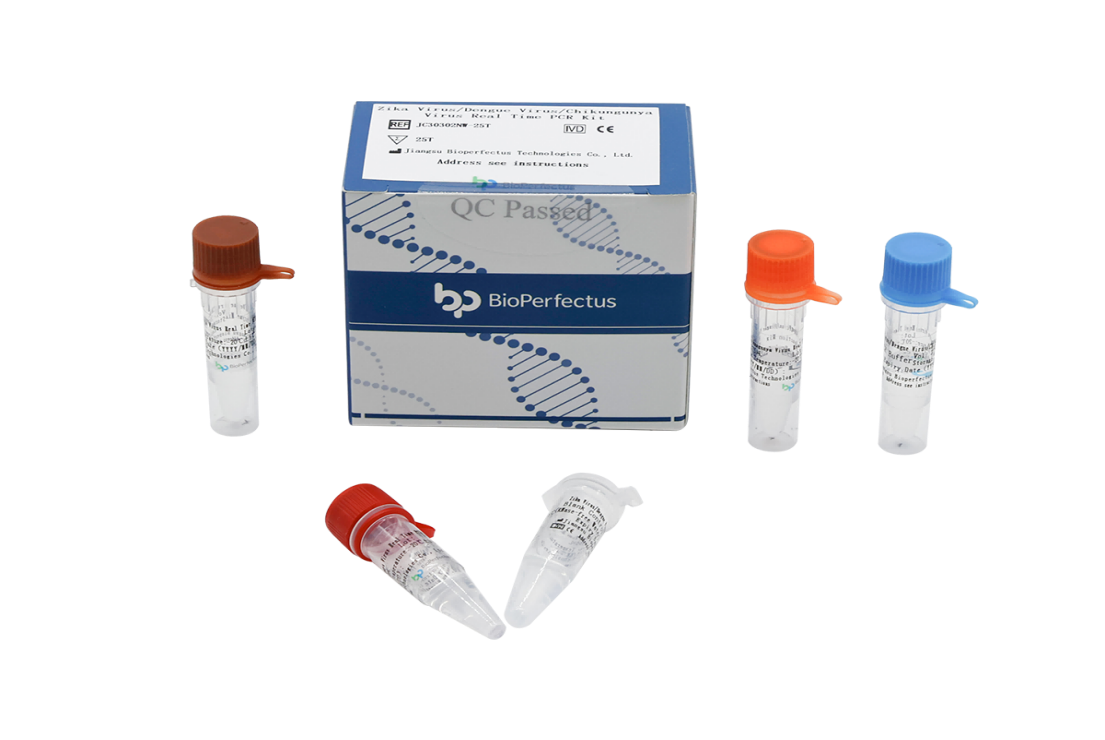
Key features of the kit include:
- Three-Virus Detection: Simultaneously detects Zika, dengue, and chikungunya virus RNA in a single multiplex PCR reaction, reducing the need for separate tests.
- Analytical Sensitivity: The manufacturer reports a detection limit of 5 copies/reaction, with a sample input volume of 5 μL.
- Defined Specimen Compatibility: Supports human serum, EDTA whole blood, and cerebrospinal fluid (CSF) for all three viruses. Urine and amniotic fluid are supported specifically for Zika virus RNA detection.
- Testing Throughput: According to BioPerfectus, the assay can process 96 tests in 79 minutes under the manufacturer's stated testing conditions.
- Built-In Quality Control: Includes an internal process control to support monitoring of the testing workflow.
Available in 25-test and 50-test configurations with a CE-IVD designation, the kit provides laboratories with a dedicated option for three-virus molecular testing.
By combining multiplex detection, defined specimen compatibility, and internal quality control, BioPerfectus supports laboratories seeking a more consolidated approach to arbovirus testing.
Conclusion
Multiplex PCR helps address the diagnostic challenges posed by dengue, Zika, and chikungunya through simultaneous viral RNA detection. Its value lies in streamlined testing, efficient specimen use, and pathogen differentiation when supported by appropriate validation and quality control.
The BioPerfectus three-virus real-time PCR kit provides a practical option for laboratories evaluating integrated arbovirus testing workflows.
References
[1] BioPerfectus. Official Website.
[2] BioPerfectus. Zika Virus / Dengue Virus / Chikungunya Virus Real Time PCR Kit.
[3] Waggoner, J. J., et al. (2016). Single-Reaction Multiplex Reverse Transcription PCR for Detection of Zika, Chikungunya, and Dengue Viruses. Emerging Infectious Diseases, 22(7), 1295–1297. https://doi.org/10.3201/eid2207.160326
[4] Cantero, C., et al. (2020). Implementation of a Multiplex rRT-PCR for Zika, Chikungunya, and Dengue Viruses: Improving Arboviral Detection in an Endemic Region. The American Journal of Tropical Medicine and Hygiene, 102(3), 625–628. https://doi.org/10.4269/ajtmh.19-0707
[5] Kingwara, L., et al. (2025). Assessment of a Multiplex Arbovirus PCR Detection Test in an Area Endemic for Chikungunya, Zika, and Dengue Viruses: An Evaluation of Kit Performance Characteristics in Line with Clinical Laboratory Improvement Amendments (CLIA) Standards. PLOS ONE, 20(6), e0309626. https://doi.org/10.1371/journal.pone.0309626
[6] Centers for Disease Control and Prevention (CDC). (2025). Clinical Testing Guidance for Dengue.
[7] Centers for Disease Control and Prevention (CDC). (2025). Serologic Tests for Dengue Virus.
