Avian influenza rarely reaches people, but the infections that do occur are often severe, and the laboratory is where they get confirmed. One unexplained respiratory swab can be the earliest sign that a bird virus has crossed into humans. What the lab does with that swab determines how quickly public health teams can respond.

Why Does Avian Influenza Still Demand Laboratory Attention?
Avian influenza keeps producing human infections with serious consequences. According to the World Health Organization (WHO) Western Pacific Region's weekly avian influenza update published on 25 September 2026, a total of 1,003 human cases of H5N1 had been reported worldwide from 1 January 2003 to 6 September 2026. The same report documented two newly reported human H9N2 cases in China, within the WHO Western Pacific Region, during 18–24 September 2026.
Which Avian Influenza Subtypes Matter Most for Human Health?
H5, H7 and H9 are the subtypes most often identified in human avian influenza infections. Wild aquatic birds, including ducks, geese and swans, act as natural reservoirs. Only some H5 and H7 viruses are classified as highly pathogenic avian influenza (HPAI) viruses.
- H5: 1,003 human H5N1 cases reported to WHO since 2003.
- H7: H7N9 caused at least 615 deaths among 1,567 human cases reported between 2013 and March 2019, according to the Public Health Agency of Canada.
- H9: New human H9N2 cases still appear in 2026 WHO bulletins.
Why Do Sporadic Human Cases Still Count as a Surveillance Signal?
A rare event is easy to miss unless a laboratory is actively testing for it. H7N9 shows why. The first human cases were reported in 2013, and by March 2019 the total had reached 1,567.
Early detection therefore buys time. When a laboratory confirms the first case quickly, public health teams can start tracing exposures before more cases appear.
Why Are Rapid Tests and Symptoms Not Enough?
Rapid tests were designed around seasonal influenza, so they can miss the viruses that matter most here. Several respiratory viruses also cause similar symptoms, which means the clinical picture alone cannot identify an avian strain.
What Can Rapid Antigen Tests Miss?
The US Centers for Disease Control and Prevention (CDC) warns that commercially available rapid influenza diagnostic tests (RIDTs) may not detect avian influenza viruses. A negative RIDT result does not exclude infection.
Consider a patient with poultry exposure and a negative rapid test. Without molecular follow-up, that patient could be sent home with a false sense of security.
CDC’s advisory highlights three limits:
- RIDTs have only moderate sensitivity.
- They cannot distinguish between influenza A subtypes.
- A negative result does not rule out infection.
Why Does Subtype Differentiation Change the Response?
A generic influenza A positive result does not tell the laboratory which virus it is handling. CDC’s protocol for suspected HPAI H5 uses a dedicated H5 primer/probe set. Specimens that are positive or inconclusive for H5 are then sent to CDC for further testing.
As a result, knowing the subtype early lets a laboratory route the specimen correctly from the start.
How Does Avian Influenza PCR Strengthen Outbreak Surveillance?
Avian influenza PCR detects viral genetic material directly, and a multiplex format can report the subtype in the same run. Polymerase chain reaction (PCR) amplifies target sequences, so it can pick up small amounts of virus that antigen tests may not.
| Question |
Rapid antigen test (RIDT) |
Multiplex H5/H7/H9 PCR |
| What it detects |
Viral antigen |
Viral RNA |
| Avian virus detection |
May not detect (CDC) |
Targets H5, H7 and H9 specifically |
| Subtype information |
Cannot distinguish subtypes (CDC) |
Differentiates three subtypes |
| Negative result |
False negatives are more likely due to lower sensitivity |
More reliable detection, but a negative result does not fully exclude infection |
What Should a Laboratory Look for in an Avian Influenza Test Kit?
Choose a kit by five criteria, not by headline claims:
- Defined specimen type: The validated sample matrix should be stated clearly.
- Subtype coverage: The targets should match the viruses you need to rule in or out.
- Sensitivity: Look for a stated limit of detection (LOD), the lowest amount of target the assay detects.
- Internal control: It should confirm the run worked.
- Instrument compatibility: The kit should run on the real-time PCR platforms you already own.
How Does a Multiplex H5/H7/H9 Workflow Compare With Single-target Testing?
A multiplex assay covers three subtypes in one workflow. Single-target assays need separate reactions to cover the same ground.
Consequently, multiplex testing uses less specimen and involves fewer setup steps when the question is “which avian subtype is this?”
What Does the BioPerfectus Avian Influenza Virus (H5/H7/H9) Real Time PCR Kit Offer?
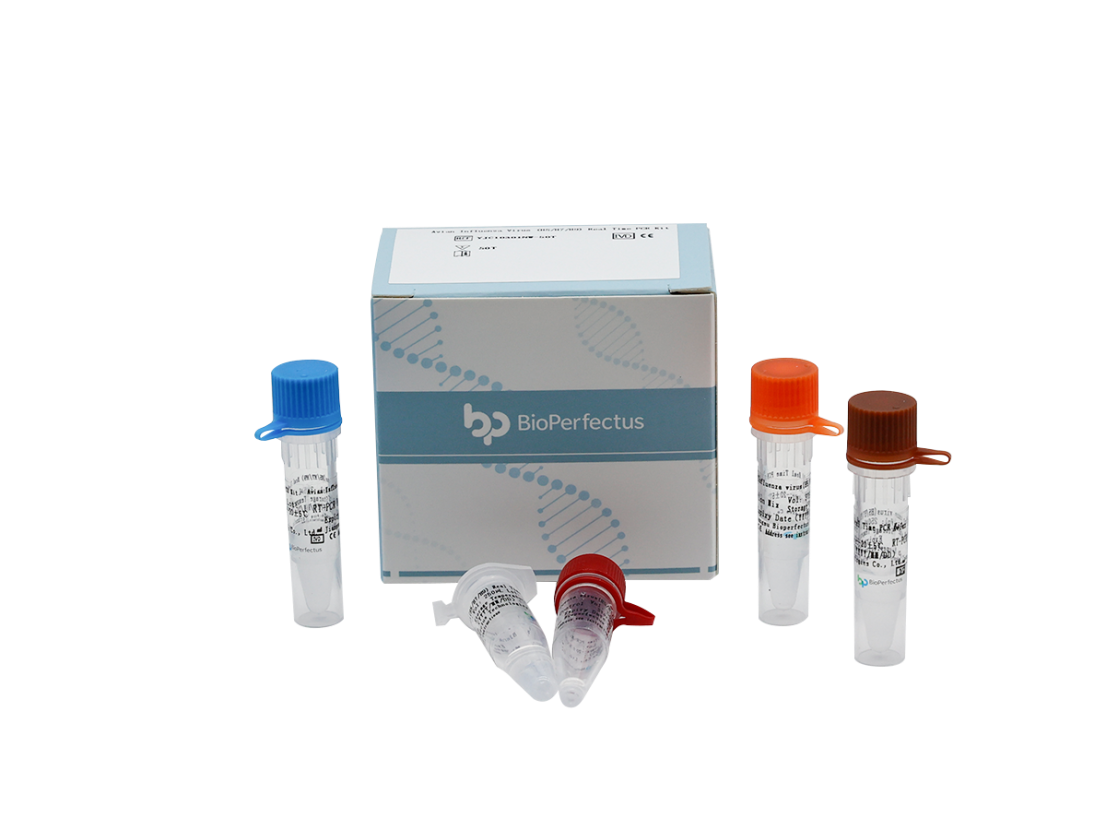
BioPerfectus is a molecular diagnostics company whose products reach laboratories in more than 100 countries and regions. Its Avian Influenza Virus (H5/H7/H9) Real Time PCR Kit is a CE-IVD-marked avian influenza test kit. It performs qualitative detection and differentiation of H5, H7 and H9 viral RNA in human nasopharyngeal and oropharyngeal swabs.

Which Everyday Laboratory Challenges Is the Kit Designed to Solve?
Each common bench problem maps to a specific kit feature:
| Lab challenge |
Kit feature |
| Three subtypes need separate runs |
Multiplex H5/H7/H9 differentiation in one workflow |
| Long turnaround during a suspected cluster |
79-minute testing time |
| Doubt about whether a negative is a true negative |
Internal control for process monitoring |
| Analytical detection limit |
Reported LOD of 5 copies/reaction, with a sample input volume of 5 μL |
| Stock and storage planning |
Storage at -20 ± 5°C, 12-month shelf life, 25T and 50T packs |
The kit also shows no cross-reaction with other viruses that cause similar symptoms. That matters when several respiratory pathogens circulate at once.
Where Does It Fit in a Reference or Public Health Laboratory Workflow?
The kit suits professional molecular laboratories handling human respiratory swabs. Typical uses include testing within programs that need clear subtype identification, subject to local protocols and the kit’s intended use.
Two boundaries apply. The kit is intended for human specimens, so it does not replace animal or environmental testing. It is also designed for compatible mainstream real-time PCR instruments, so laboratories should confirm their platform with BioPerfectus before adoption.
Conclusion: How Should Laboratories Prepare for the Next Avian Influenza Signal?
Laboratories should treat avian influenza PCR as a standing capability, not an emergency purchase. Rapid tests cannot rule out avian infection, while subtype identification provides valuable information for outbreak surveillance and response.
Start with these actions:
- Review your current algorithm for patients with suspected avian influenza exposure.
- Check that your real-time PCR instruments support a multiplex H5/H7/H9 assay.
- Plan reagent stock around shelf life and storage conditions.
- Align referral steps with your national public health laboratory.
For laboratories that also run broader flu programs, BioPerfectus’ Influenza Total Solution shows how the avian panel can sit alongside the rest of the influenza portfolio.
References
