A recently published Phase 3 study in The New England Journal of Medicine reported new data from the B-Well 1 and B-Well 2 trials, bringing renewed attention to functional cure strategies in chronic hepatitis B and the laboratory monitoring required to evaluate treatment response.
Background
Chronic hepatitis B virus (HBV) infection remains a major global health challenge. The NEJM article notes that chronic HBV infection affects approximately 240 million people worldwide and causes more than one million deaths each year. Beyond the clinical burden, patients may also face reduced quality of life, stigma, and discrimination.
For chronic HBV infection, functional cure is an important therapeutic goal. In the B-Well study publication, functional cure was defined as a sustained HBV DNA level below the lower limit of quantification (LLOQ) together with hepatitis B surface antigen (HBsAg) loss for at least 24 weeks after fixed-duration therapy, with or without hepatitis B surface antibody positivity.
Currently approved therapies, including nucleoside or nucleotide analogues (NAs) and pegylated interferon, can suppress viral replication, but HBsAg loss is rarely achieved. Against this background, bepirovirsen, an investigational unconjugated antisense oligonucleotide designed to target HBV transcripts, has been evaluated as a finite-duration therapeutic strategy in patients with NA-suppressed chronic HBV infection.
Study Design
B-Well 1 and B-Well 2 were replicate, double-blind, placebo-controlled Phase 3 trials conducted across 29 countries in Europe, the Asia-Pacific region, and the Americas. Adults with documented chronic HBV infection were eligible if they were receiving stable NA therapy, had no planned regimen change, and had no cirrhosis according to protocol-defined criteria.
Eligible patients had baseline HBsAg levels between 100 and 3000 IU/mL, HBV DNA levels below 90 IU/mL, and alanine aminotransferase (ALT) levels no more than two times the upper limit of the normal range. Patients were stratified according to screening HBsAg levels: a lower HBsAg stratum (100 to 1000 IU/mL) and a higher HBsAg stratum (1000 to 3000 IU/mL).
Participants were randomly assigned in a 2:1 ratio to receive either weekly subcutaneous bepirovirsen at 300 mg or placebo for 24 weeks, with additional loading doses on days 4 and 11. All patients continued background NA therapy during the treatment period and then remained on NA therapy through weeks 24 to 48.
At week 48, eligible patients discontinued NA therapy. Eligibility for NA discontinuation required HBV DNA below the LLOQ (<20 IU/mL or not detected), HBsAg not detected (<0.05 IU/mL) from week 24 to week 46, ALT no more than two times the upper limit of the normal range, and HBeAg negativity at week 46. The primary outcome was functional cure at week 72, assessed 24 weeks after discontinuation of all HBV therapy in eligible patients.
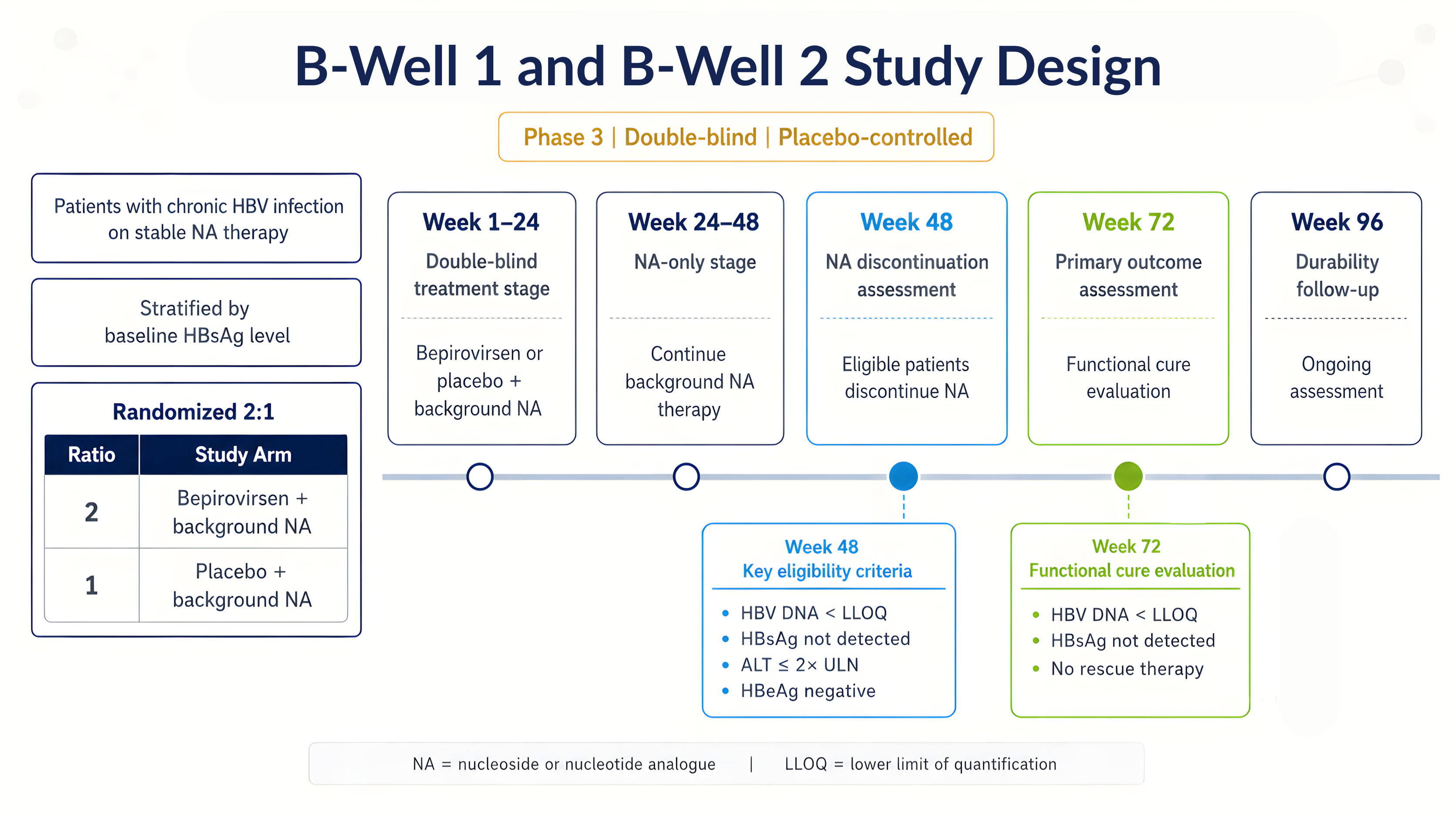
Figure 1. B-Well 1 and B-Well 2 study design. The trials used a randomized, double-blind, placebo-controlled design with 2:1 assignment to bepirovirsen or placebo on background NA therapy, followed by NA discontinuation assessment at week 48 and primary outcome assessment at week 72.
Key Results
Functional cure at Week 72
At week 72, the percentage of patients with functional cure was significantly higher in the bepirovirsen groups than in the placebo groups in both trials. In B-Well 1, functional cure was reported in 127 of 650 patients (20%) receiving bepirovirsen, compared with none of 328 patients receiving placebo. In B-Well 2, functional cure was reported in 106 of 570 patients (19%) receiving bepirovirsen, compared with none of 286 patients receiving placebo.
These results indicate that, in the studied population of patients with NA-suppressed chronic HBV infection and baseline HBsAg levels of 100 to 3000 IU/mL, a finite 24-week course of bepirovirsen was associated with functional cure in approximately one in five patients at week 72.
Higher response in the lower baseline HBsAg stratum
The treatment effect was more pronounced among patients with lower baseline HBsAg levels. In the lower HBsAg stratum (baseline HBsAg ≤1000 IU/mL), functional cure was reported in 105 of 426 patients (25%) receiving bepirovirsen in B-Well 1 and 95 of 342 patients (28%) receiving bepirovirsen in B-Well 2. No patients in the corresponding placebo groups achieved functional cure.
By comparison, in the higher HBsAg stratum, functional cure was reported in 10% of patients receiving bepirovirsen in B-Well 1 and 5% in B-Well 2. These findings suggest that baseline HBsAg level may be an important factor when interpreting response to finite-duration HBV treatment strategies.
Sustained HBV DNA suppression after NA discontinuation
At week 48, NA therapy was discontinued in 24% of patients in the bepirovirsen group in both B-Well 1 and B-Well 2, based on laboratory-defined eligibility criteria. Among patients in the lower baseline HBsAg stratum, NA discontinuation occurred in 31% of patients in B-Well 1 and 33% in B-Well 2.
A sustained HBV DNA level below the LLOQ at week 72 after NA discontinuation was reported in 151 of 650 patients (23%) receiving bepirovirsen in B-Well 1 and 132 of 570 patients (23%) receiving bepirovirsen in B-Well 2, while no patients in the placebo groups met this endpoint.
Among patients in the lower baseline HBsAg stratum, sustained HBV DNA below the LLOQ after NA discontinuation was reported in 124 of 426 patients (29%) in B-Well 1 and 113 of 342 patients (33%) in B-Well 2. These data reinforce the importance of sensitive HBV DNA monitoring during post-treatment follow-up.
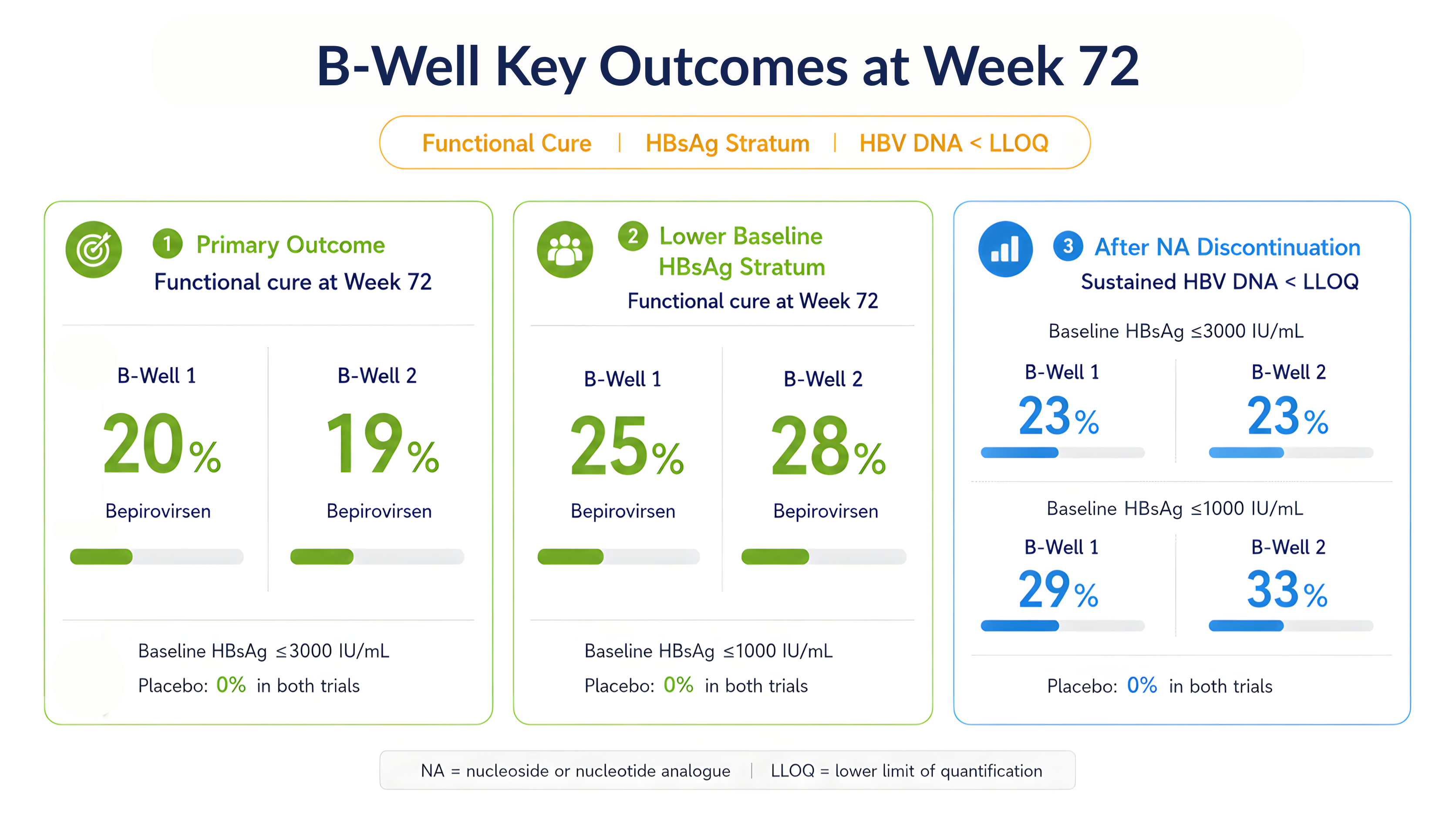
Figure 2. Key outcomes at week 72 in B-Well 1 and B-Well 2. The figure summarizes functional cure rates in the trial population with baseline HBsAg ≤3000 IU/mL and in the lower baseline HBsAg ≤1000 IU/mL stratum, along with sustained HBV DNA below LLOQ after NA discontinuation.
Safety Overview
The safety profile of bepirovirsen was generally consistent across B-Well 1 and B-Well 2. In pooled data through week 72, adverse events were reported in 91% of patients in the bepirovirsen groups and 73% of patients in the placebo groups; serious adverse events were reported in 7% and 4% of patients, respectively.
During the 24-week treatment period, adverse events were reported in 89% of patients receiving bepirovirsen and 65% of patients receiving placebo. Injection-site reactions were the most common adverse events of special interest, reported in 53% of patients receiving bepirovirsen and 14% of those receiving placebo. Most injection-site reactions were mild and occurred most commonly during the first four weeks of treatment.
Grade 3 or higher adverse events during the treatment period were reported in 16% of patients receiving bepirovirsen and 3% of patients receiving placebo. ALT elevation was the most common grade 3 or higher adverse event in the bepirovirsen groups. The publication also reported that no patients met criteria for drug-induced liver injury, and that observed decreases in mean platelet count and estimated glomerular filtration rate returned to near baseline by week 72.
Implications for HBV DNA and HBsAg Monitoring
Although B-Well 1 and B-Well 2 evaluated an investigational therapeutic approach, the study also underscores a broader diagnostic message: functional cure strategies depend on precise, longitudinal laboratory monitoring.
In the trial design, HBV DNA and HBsAg measurements were essential at multiple stages. Baseline HBV DNA suppression and HBsAg level defined key eligibility and stratification parameters. At week 48, NA discontinuation required HBV DNA below the LLOQ and HBsAg loss, along with other laboratory criteria. At week 72, the primary outcome again depended on HBV DNA below the LLOQ, HBsAg not detected, and no rescue therapy.
For clinical laboratories and healthcare systems, these findings highlight the need for reliable HBV DNA testing and standardized serological monitoring when evaluating finite-therapy strategies, treatment response, NA discontinuation eligibility, and post-treatment durability.
As a molecular diagnostics company focused on infectious diseases, BioPerfectus recognizes the growing importance of sensitive and standardized testing in chronic HBV management. Advances in therapeutic research may change how patients are monitored, but accurate HBV DNA and HBsAg assessment will remain fundamental to clinical decision-making and long-term follow-up.
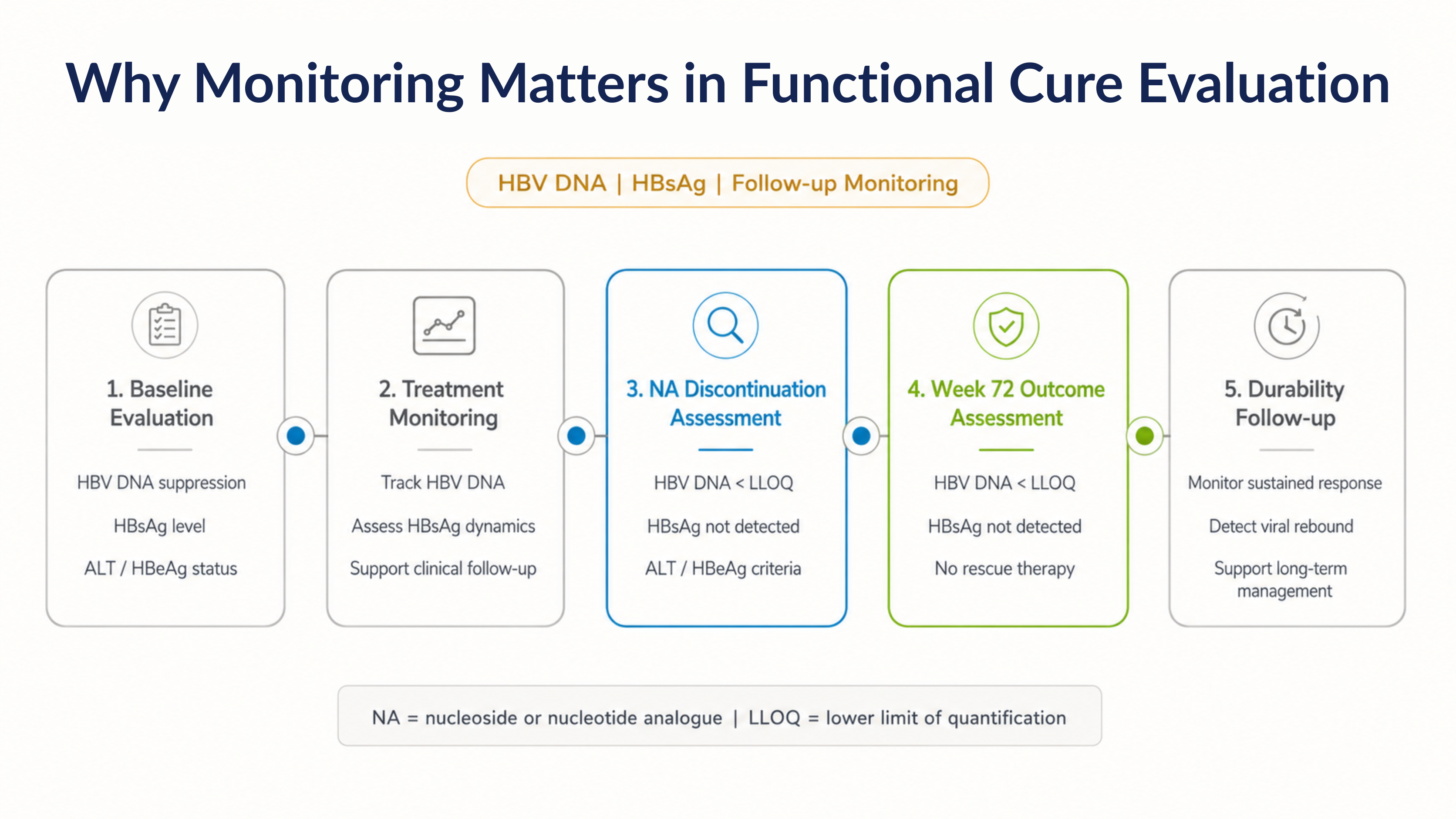
Figure 3. Diagnostic monitoring pathway in functional cure evaluation. HBV DNA, HBsAg, ALT/HBeAg, and follow-up monitoring support baseline evaluation, NA discontinuation assessment, week 72 outcome assessment, and durability follow-up.
Conclusion
The Phase 3 B-Well 1 and B-Well 2 trials represent an important development in chronic HBV research. In both trials, functional cure at week 72 was reported in a significantly higher proportion of patients receiving bepirovirsen than in those receiving placebo, with higher response rates observed among patients with lower baseline HBsAg levels.
At the same time, the study demonstrates that functional cure is not defined by a single result. It requires sustained virological suppression, HBsAg loss, careful assessment of NA discontinuation eligibility, and continued follow-up after therapy. As finite-treatment strategies evolve, high-quality HBV DNA and HBsAg monitoring will continue to play a central role in supporting evidence-based chronic HBV management.
Reference
Hou, J., Lim, S. G., Buti, M., Yuen, M. F., Gane, E., Lampertico, P., ... & Elston, R. (2026). Phase 3 Results of Bepirovirsen Treatment for Chronic Hepatitis B Virus Infection. New England Journal of Medicine, 394(24), 2395–2406.
