Why Does Nucleic Acid Extraction Quality Matter Before PCR Even Starts?
Poor nucleic acid extraction quality is one of the most common reasons a PCR (polymerase chain reaction) or RT-qPCR (reverse transcription quantitative PCR) test underperforms. Amplification can only work with the template it is given, so a compromised sample limits the result before the thermal cycler ever starts. Extraction is therefore not a preliminary step — it is the foundation the rest of the workflow depends on.
What Happens When RNA or DNA Is Degraded or Impure?
Degraded or impure nucleic acid directly lowers assay sensitivity. This happens because fragmented RNA or DNA gives the polymerase fewer intact target sequences to copy. For example, samples exposed to repeated freeze-thaw cycles or prolonged room-temperature storage typically show reduced yield. As a result, a genuinely positive sample can return a weak or borderline signal.
How Do Extraction Failures Cause False Negatives?
Extraction failures can contribute to false-negative results through carried-over inhibitors. Common culprits include residual ethanol from wash buffers, heme from blood samples, and mucins from respiratory or gastrointestinal swabs. Because these substances interfere with polymerase activity, even a sample containing sufficient target nucleic acid may fail to amplify. Laboratories investigating unexpected negative results may trace the cause back to sample preparation rather than the assay chemistry itself.
What Do MIQE Guidelines Say About Extraction and Reproducibility?
The MIQE (Minimum Information for Publication of Quantitative Real-Time PCR Experiments) guidelines identify nucleic acid extraction as an important variable that can affect experimental outcomes. First published by Bustin and colleagues in Clinical Chemistry and later updated as MIQE 2.0, the guidelines call for detailed documentation of extraction methods, sample sources, and nucleic acid quality controls. Because qPCR is sensitive to small variations, MIQE treats extraction reporting as essential rather than optional.
Why Is RNA Integrity a "Minimum" Reporting Requirement?
RNA integrity is listed as essential because degradation can be difficult to identify after the fact. Fleige and Pfaffl, writing in Molecular Aspects of Medicine, note that RNA purity and RNA integrity are separate properties — a sample can appear pure by concentration readings while still being degraded. Both properties therefore require appropriate assessment rather than a single pass/fail check.
How Do Magnetic Bead Extraction Kits Solve These Problems?
Magnetic bead extraction addresses inhibitor carryover and low yield by binding nucleic acid to bead surfaces, then washing away contaminants before elution. Because the beads move with a magnet instead of a centrifuge, the method also reduces a source of manual-technique variation. BioPerfectus applies this approach across its nucleic acid extraction portfolio, including kits designed specifically for viral sample workflows.
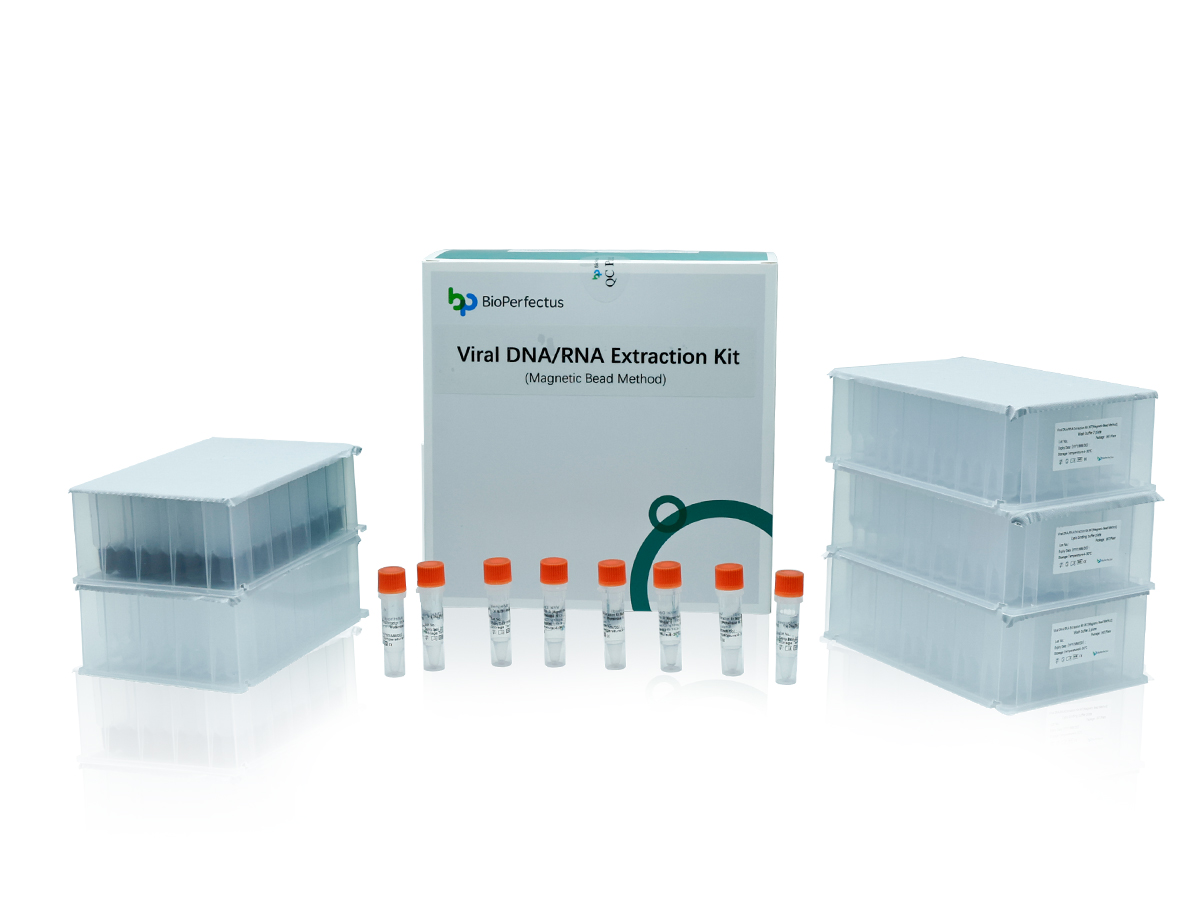
What Makes BioPerfectus's Viral DNA/RNA Extraction Kit Different?
Unlike extraction workflows that need a separate protocol for each sample matrix, the Viral DNA/RNA Extraction Kit (Magnetic Bead Method) runs whole blood, serum, plasma, urine, swabs, tissue-lapping fluid, and other liquid samples through the same wash and elution parameters. That single-protocol design helps limit sample-to-sample variability because the process does not change based on which matrix is loaded. It processes 1–48 samples per run and completes extraction in 25–35 minutes, with nucleic acid recovery of 85% or higher.
| Parameter |
Specification |
| Sample volume |
200 µL–800 µL |
| Elution volume |
70 µL |
| Recovery |
≥85% (nucleic acid) |
| Processing time |
25–35 minutes |
| Throughput |
1–48 samples |
| Certifications |
CE-IVDR, FDA-Listed, NMPA |
Because recovery and processing time are documented and the workflow is standardized, laboratories can move eluted output from this DNA and RNA extraction kit directly into PCR, qPCR, or NGS (next-generation sequencing) workflows while reducing extraction-related variability as a potential source of inconsistent downstream signals.
How Does the Extraction Method You Choose Affect Sensitivity and Reproducibility?
The extraction method itself can introduce or reduce variability before amplification begins. Manual, column-based, and magnetic bead methods differ mainly in how consistently they handle wash and elution steps across a batch. Since these steps determine how much inhibitor remains and how much nucleic acid is recovered, the choice of method can affect downstream Cq (quantification cycle) values.
Why Do Manual and Column-Based Methods Introduce More Run-to-Run Variability?
Manual and column-based methods can introduce variability because each wash and centrifugation step depends on operator timing and technique. Incomplete removal of ethanol wash buffer, for instance, is a documented cause of PCR inhibition in column-based workflows. Because this step is repeated by hand across many samples, small timing differences can accumulate into batch-to-batch variation.
How Does Magnetic Bead Automation Improve Consistency Across Samples?
Magnetic bead automation can improve consistency by applying standardized wash volumes, timing, and magnetic separation conditions to samples within a run. Sample-to-sample variation may therefore be reduced compared with manual pipetting and centrifugation. This is particularly relevant in viral RNA extraction workflows, where low viral load samples leave little margin for recovery loss.
| Method |
Operator Dependency |
Typical Variability Driver |
| Manual extraction |
High |
Inconsistent wash and lysis timing |
| Column-based |
Moderate |
Residual ethanol, centrifugation variance |
| Magnetic bead (automated) |
Low |
Standardized wash and separation cycles |

How Can Labs Verify Extraction Quality Before Running PCR?
Labs can verify extraction quality by running extraction controls and internal controls alongside patient or research samples. An extraction control passes through the same purification steps as the samples, helping confirm that recovery and inhibitor removal worked as expected. An internal control added to each sample can help distinguish a valid negative result from one affected by extraction failure or assay inhibition.
What Role Do Extraction Controls and Internal Controls Play?
These controls help identify where a failure may have occurred. If the internal control fails while the target result is negative, the laboratory should consider PCR inhibition or nucleic acid loss during extraction rather than automatically assuming a true negative. Routine use of both control types is a practical way to identify extraction problems before results are reported.
- Run an extraction control with every batch.
- Add an internal control to each individual sample.
- Flag failed internal controls for repeat testing before reporting results.
Conclusion — What Should Labs Prioritize for Reliable PCR Results?
Laboratories should prioritize extraction consistency because it influences how much of the sensitivity and reproducibility built into a PCR or RT-qPCR assay reaches the final result. Choosing a validated DNA and RNA extraction kit, following MIQE-aligned documentation practices, and running extraction and internal controls together can help reduce the risk of false negatives and run-to-run drift. As daily testing volumes grow, magnetic bead-based extraction offers one way for laboratories to standardize this step across their workload.
References
Bustin SA, Benes V, Garson JA, Hellemans J, Huggett J, Kubista M, et al. The MIQE Guidelines: Minimum Information for Publication of Quantitative Real-Time PCR Experiments. Clinical Chemistry. 2009;55(4):611–622.
Bustin SA, Ruijter JM, van den Hoff MJB, Kubista M, Pfaffl MW, Shipley GL, et al. MIQE 2.0: Revision of the Minimum Information for Publication of Quantitative Real-Time PCR Experiments Guidelines. Clinical Chemistry. 2025;71(6):634–651.
Fleige S, Pfaffl MW. RNA Integrity and the Effect on the Real-Time qRT-PCR Performance. Molecular Aspects of Medicine. 2006;27(2–3):126–139.
