A viral RNA extraction kit is a set of reagents and consumables designed to release, capture, purify, and elute viral RNA from biological specimens for downstream molecular testing.
When selecting and comparing kits, consider more than the reported recovery or yield. Review whether the sample matrix, expected target abundance, elution conditions, platform capacity, and downstream assay requirements align with the intended workflow. Where possible, evaluate candidate kits with representative specimens and assess performance from nucleic acid extraction through downstream detection.


Which Sample Features Matter Most?
The sample matrix is the first selection filter. A 2025 review concludes that no single RNA extraction method is suitable for every specimen type; sample type and viral characteristics need to inform the choice (Artika et al., 2025).
Swabs in transport medium, plasma, serum, whole blood, urine, and tissue-derived fluids differ in composition and may present different extraction challenges. A viral RNA extraction kit evaluated with one matrix may therefore need local verification before use with another.
Input and elution volumes also belong in the comparison. MIQE 2.0 lists sample type, amount processed, extraction method, elution volume, extraction blanks, percent yield, and nucleic acid quality among the details relevant to quantitative PCR reporting (Bustin et al., 2025).
When reviewing a kit, compare its listed matrices, permitted input range, pretreatment needs, and transport-medium compatibility with the laboratory's actual specimens. Unlisted matrices are best treated as a validation question.
A DNA and RNA extraction kit can support programs that test viruses with either genome type. That scope does not establish equal recovery for every target. Each DNA/RNA extraction workflow can be assessed with representative matrices and target concentrations.
How Can Sensitivity Be Judged Realistically?
Analytical sensitivity belongs to the complete workflow, not to extraction alone. Performance in an RT-qPCR-based testing workflow depends on sample collection, nucleic acid extraction, reverse transcription, amplification, and data analysis. Reverse transcription quantitative PCR (RT-qPCR) includes collection, lysis, purification, elution, reverse transcription, amplification, and analysis.
A recovery percentage describes nucleic acid recovered under specified conditions. It is not interchangeable with limit of detection (LoD), viral RNA-specific recovery in every matrix, or clinical sensitivity.
MIQE 2.0 calls for detection limits and dynamic ranges for each target and recommends efficiency-corrected target quantities rather than reliance on raw quantification cycle (Cq) values alone.
The same guidance includes extraction replicates, blanks, yield, and quality measurements. These elements help separate extraction variability from amplification variability.
- Recovery and repeatability in representative negative, low-positive, and mid-range samples
- Internal-control behavior that can reveal extraction loss or amplification inhibition
- Negative extraction controls that can indicate contamination introduced during processing
- Eluate volume and the fraction of eluate entering the downstream reaction
Cq shifts can be informative when the assay, threshold method, input, and calibration remain consistent. On their own, they do not establish universal kit performance.
What Does Extraction Chemistry Change?
Silica spin columns and coated magnetic beads both use solid-phase binding, washing, and elution.
In a magnetic-bead workflow, nucleic acids bind to coated particles, a magnetic field immobilizes the particles, and wash steps remove other material before elution. The method can avoid centrifugation and can be automated.
Manual columns may fit small batches with available centrifugation, while magnetic beads may fit variable batch sizes or automated processing.
Binding chemistry, wash performance, carryover, matrix, and instrument settings can all affect the result.
What Defines Platform Compatibility?
Compatibility extends beyond whether a reagent container fits an instrument. Review the specified instrument model and program, reagent and mixing volumes, magnetic configuration, plastics, batch range, loading pattern, and consumable format. Minimum and maximum batch sizes can then be compared with routine workload and turnaround targets.
Downstream use also matters. Extracted material may be intended for polymerase chain reaction (PCR), RT-qPCR, or next-generation sequencing (NGS). For viral NGS, low viral abundance relative to host nucleic acid can create an additional challenge.
| Checkpoint |
What to Verify |
| Instrument |
Named model, validated protocol, run settings, and maintenance needs |
| Workload |
Batch flexibility, run time, hands-on steps, and repeat handling |
| Downstream assay |
Elution volume, input per reaction, inhibition, and storage conditions |
| Quality system |
Controls, lot records, traceability, waste handling, and contamination safeguards |
The following table summarizes key selection considerations for common application scenarios.
| Selection Scenario |
Key Considerations |
| Low viral load samples |
Low-positive detection performance, repeatability, sample input volume, elution volume, and the fraction of eluate used in the downstream reaction |
| Different sample matrices |
Pretreatment requirements, transport-medium compatibility, and residual inhibitors |
| Small batches or irregular sample arrivals |
Minimum batch size, consumable utilization, and hands-on time |
| Automated batch processing |
Specific instrument model, run protocol, compatible consumables, and cross-contamination control |
| Downstream NGS |
Nucleic acid input quantity and quality required for library preparation, and validation status of the corresponding workflow |
How Can a Candidate Workflow Be Verified?
A short pilot can compare candidate workflows under the conditions that matter locally. Include representative matrices, negatives, and samples near the intended LoD, with replicate testing across runs.
If the workflow will involve several operators, instruments, or reagent lots, the study design can include those sources of variation. Acceptance criteria can be defined before testing and linked to the intended use.
The August 2025 WHO information for molecular detection of influenza viruses uses sterile water as a negative extraction control alongside specimens and includes internal positive controls in specified protocols (WHO, 2025).
MIQE 2.0 likewise emphasizes controls, repeatability, reproducibility, LoD, and dynamic range. Together, these recommendations support evaluating the entire method rather than accepting a kit-level metric as a diagnostic performance claim.
Record sample input, elution volume, storage conditions, control results, invalid rates, deviations, and lot information.
If a viral RNA extraction kit changes, a bridging comparison can help determine whether assay thresholds or interpretation rules remain appropriate.
Matching Product Specifications to Your Workflow Needs
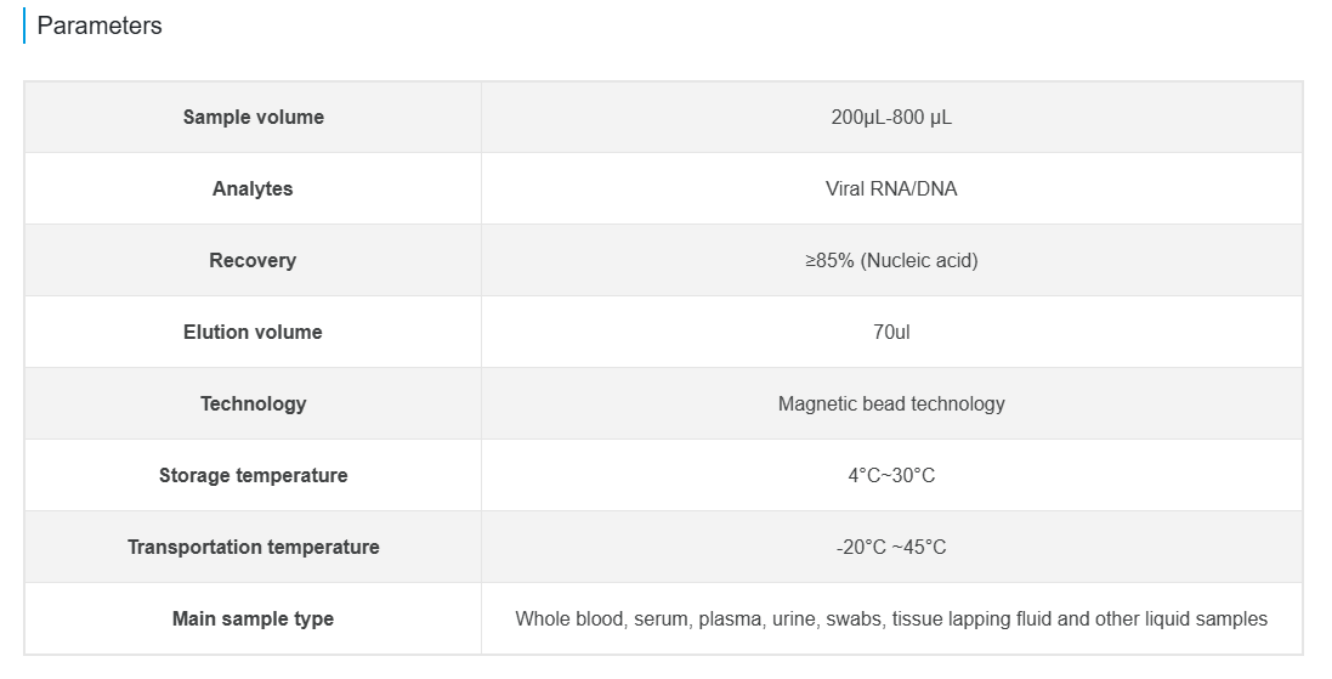
After the scientific criteria are defined, product specifications can help populate a shortlist. The BioPerfectus Viral DNA/RNA Extraction Kit (Magnetic Bead Method) is designed for whole blood, serum, plasma, urine, swabs, tissue-lapping fluid, and other liquid samples.
The parameters include 200 to 800 microliters of input, 70 microliters of elution, at least 85% nucleic acid recovery, automated processing of 1 to 48 samples, and a 25 to 35 minute extraction time on the specified extraction platform.
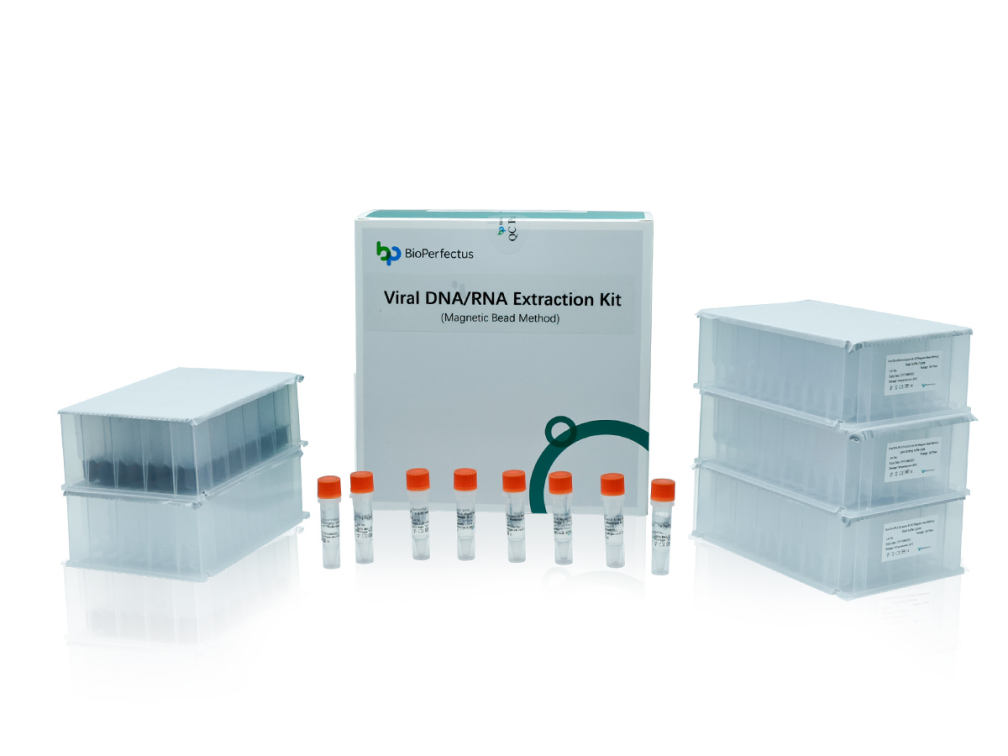
BioPerfectus Viral DNA/RNA Extraction Kit (Magnetic Bead Method).
Those values can be compared with the intended matrix, workload, and downstream assay. The listed recovery value remains a product parameter; it does not by itself define LoD or clinical sensitivity.
Conclusion
A suitable viral RNA extraction kit depends on the fit among specimen, target level, chemistry, platform, and downstream assay. Current guidance suggests documenting input, elution, controls, yield, detection limits, and reproducibility. Checking the full workflow with representative samples and predefined criteria keeps product specifications in context and can reduce reliance on any single metric.
References
[1] Artika, M. I., Ma'roef, C. N., Johar, E., Yudhaputri, F. A., & Myint, K. S. A. (2025). Comprehensive Review on Viral RNA Extraction Strategies for Enhanced Molecular Diagnostics. Interdisciplinary Perspectives on Infectious Diseases, 2025, 5579320. https://doi.org/10.1155/ipid/5579320
[2] Bustin, S. A., Ruijter, J. M., van den Hoff, M. J. B., Kubista, M., Pfaffl, M. W., Shipley, G. L., Tran, N., Rödiger, S., Untergasser, A., Mueller, R., Nolan, T., Milavec, M., Burns, M. J., Huggett, J. F., Vandesompele, J., & Wittwer, C. T. (2025). MIQE 2.0: Revision of the Minimum Information for Publication of Quantitative Real-Time PCR Experiments Guidelines. Clinical Chemistry, 71(6), 634–651. https://doi.org/10.1093/clinchem/hvaf043
[3] World Health Organization. (2025). WHO information for the molecular detection of influenza viruses (11th revision, August 2025). WHO guidance document
