Measles and rubella can start with overlapping fever and rash, but outbreak decisions depend on accurate identification. The World Health Organization (WHO) estimated 11 million measles infections in 2024, and 59 countries experienced large or disruptive outbreaks. [1] A practical Measles and Rubella viruses test real-time PCR kit links early case recognition, appropriate specimen collection, controlled ribonucleic acid (RNA) extraction, multiplex testing, and public health follow-up.
What a Measles/Rubella Viruses PCR Test Kit Detects
A Measles/Rubella test kit uses molecular targets to help identify and distinguish two RNA-virus infections that can present as febrile rash illness.
Measles is a highly contagious airborne disease that can cause fever, cough, coryza, conjunctivitis, and a generalized rash. Rubella often causes a milder rash illness, but infection during pregnancy can lead to miscarriage, fetal death, or congenital rubella syndrome. WHO estimates that about 100,000 infants are born with congenital rubella syndrome worldwide each year. [2,3]
Real-time reverse transcription polymerase chain reaction (real-time RT-PCR) first converts viral RNA into complementary DNA, then amplifies and monitors selected genetic targets. A multiplex assay detects more than one target in the same reaction. In a measles and rubella assay, separate fluorescence channels can differentiate the two viruses while an internal control monitors the testing process. [4]
Why Multiplex RT-PCR Matters in an Outbreak
Multiplex RT-PCR helps resolve clinical overlap while using one specimen aliquot and one amplification reaction for related diagnostic questions.
Timing remains important. For measles, the US Centers for Disease Control and Prevention (CDC) notes that RNA detection is most successful from the first day of rash through the following three days, although detection may remain possible 10 to 14 days after rash onset. [5] For rubella, RT-PCR sensitivity is highest within the first three days of rash onset; viral RNA can still be detected nine days after onset in about 50% of patients. [6]
Molecular testing is one part of case classification. WHO guidance supports collecting specimens for molecular and serologic testing at first contact with a suspected case. Clinical findings, vaccination history, exposure, travel, and local epidemiology also inform interpretation. [6,7]
The Best Practice Multiplex PCR Outbreak Workflow
A reliable workflow protects specimen quality and connects verified results with public health action.
1. Recognize the case and coordinate testing
The workflow begins when fever and rash, respiratory symptoms, an epidemiologic link, or relevant travel raises suspicion. Public health contact can clarify isolation, reporting, routing, and referral requirements before collection. [5,6]
2. Collect the specimen early
For the BioPerfectus assay, the validated specimen is a throat swab. Collect throat swab specimens as soon as infection is suspected, following the assay instructions and applicable public health guidance. Collect specimens as soon as infection is suspected, following the kit instructions and applicable public health guidance. For example, the BioPerfectus Measles and Rubella Viruses Real-Time PCR Kit is validated for throat swab specimens.
Collection close to symptom or rash onset can improve the opportunity for RNA detection. Patient identifiers, collection time, rash onset, vaccination history, and transport conditions help the laboratory assess specimen suitability. [5,8]
3. Control the RNA extraction stage
DNA and RNA extraction workflows form the preanalytical bridge between the throat swab and amplification. A viral RNA extraction kit can lyse the specimen, separate nucleic acid, remove inhibitors, and provide RNA for reverse transcription. A DNA and RNA extraction kit can also serve mixed molecular menus when its throat-swab matrix and downstream assay compatibility are validated.
Selection factors include input and elution volumes, inhibitor removal, contamination control, throughput, traceability, and compatibility with the PCR instructions. The selected viral RNA extraction kit needs to preserve RNA across the defined workflow. If a DNA and RNA extraction kit is used, its performance remains linked to the validated specimen, extraction method, and amplification system.
Consistent DNA and RNA extraction can help reduce avoidable invalid results, but extraction cannot correct a poor specimen. A viral RNA extraction kit or DNA and RNA extraction kit can be assessed through internal controls and run controls. DNA/RNA extraction records can document sample identity, reagent lot, run, operator, and deviations.
4. Run multiplex real-time RT-PCR with controls
WHO describes one-step real-time RT-PCR as combining reverse transcription and amplification in one reaction, which reduces repeated pipetting. A validated run includes appropriate positive and negative controls under the laboratory procedure. The internal control helps monitor specimen quality and process performance; an absent control signal can make a negative target result invalid. [4]
5. Interpret results within the case context
Target channels and the internal-control channel are interpreted according to the assay instructions. A valid positive can support laboratory confirmation, while a negative result does not always exclude infection. Collection timing, specimen quality, transport, prior vaccination, and epidemiologic evidence remain relevant. Quantification cycle thresholds and retest rules are assay- and instrument-specific. [5,6]
6. Report and refer when indicated
Results can be communicated through the required clinical and public health channels. Reference-laboratory sequencing or genotyping can help distinguish vaccine-associated detection from wild-type virus and can support transmission analysis. A Measles/Rubella Test Kit differentiates measles from rubella; it does not replace genomic characterization. [6,7]
How the BioPerfectus Test Kit Fits the Workflow
The BioPerfectus Measles and Rubella Viruses Real-Time PCR Kit is designed for qualitative detection and differentiation of measles virus and rubella virus nucleic acids in throat swabs.
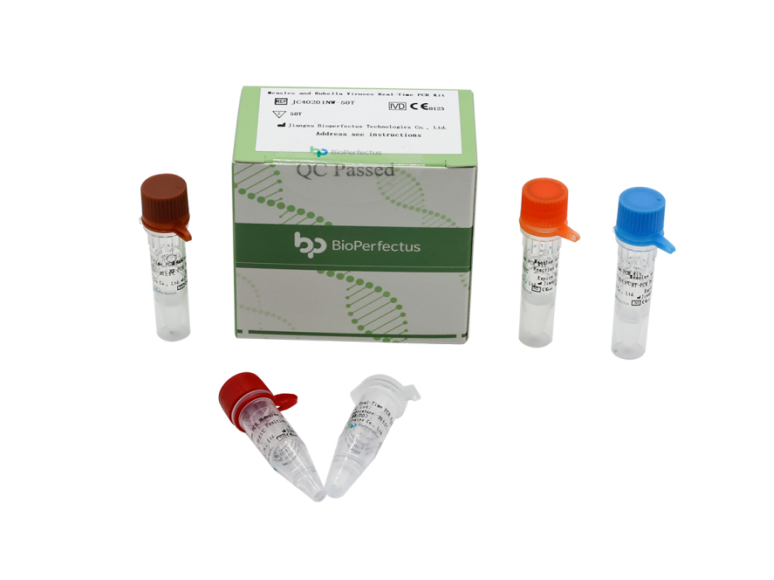
Measles and Rubella Viruses Real-Time PCR Kit.
The multiplex design targets the measles virus N gene and rubella virus E1 gene. Human RNase P serves as the internal control. The listed sample input is 5 microliters, and the workflow capacity is 96 tests in 109 minutes on compatible real-time PCR instruments.
Limits of detection are expressed as 50% tissue culture infectious dose per milliliter (TCID50/mL).
| Feature |
BioPerfectus Assay Specification |
| Intended result |
Qualitative detection and differentiation of measles and rubella viral nucleic acids |
| Validated specimen |
Throat swab |
| Targets |
Measles N gene, rubella E1 gene, and RNase P internal control |
| Clinical sensitivity |
100% for measles and 100% for rubella under the evaluated conditions |
| Clinical specificity |
99.5% for measles and 99.6% for rubella under the evaluated conditions |
| Limit of detection |
10 TCID50/mL for measles and 20 TCID50/mL for rubella |
| Regulatory status |
CE marked under the EU In Vitro Diagnostic Regulation (CE-IVDR); availability can vary by market |
Performance note. Performance values apply to the evaluated conditions. Local verification, laboratory procedures, and market-specific regulatory requirements remain relevant.
How to Review an Outbreak Testing Setup
A suitable Measles/Rubella Test Kit workflow matches the assay's intended use with the laboratory's specimen, extraction, capacity, quality, and referral arrangements.
- Confirm that the patient population and throat-swab specimen match the intended use.
- Verify the viral RNA extraction kit or DNA and RNA extraction kit with the complete assay workflow.
- Review internal control behavior, external run controls, invalid-result rules, and contamination controls.
- Assess throughput against staffing, collection patterns, transport time, and surge demand.
- Define reporting, serology, repeat collection, sequencing, and genotyping pathways before an outbreak surge.
Conclusion
An effective Measles and Rubella Test Kit workflow begins before amplification. Case recognition, early throat-swab collection, controlled RNA extraction, multiplex RT-PCR, qualified interpretation, and public health referral work as one process.
The BioPerfectus products can support detection and differentiation when used within their validated specimen type and instructions. Meanwhile, vaccination history, serology, and epidemiologic findings remain part of outbreak decisions.
References
[1] World Health Organization. Measles deaths down 88% since 2000, but cases surge. November 28, 2025.
[2] World Health Organization. Measles. July 15, 2026.
[3] World Health Organization. Rubella. July 15, 2026.
[4] World Health Organization. Manual for the Laboratory-based Surveillance of Measles, Rubella, and Congenital Rubella Syndrome. Chapter 6: Detection of viral RNA by RT-PCR for the confirmation of measles and rubella infection.
[5] Centers for Disease Control and Prevention. Laboratory Testing for Measles. June 12, 2024.
[6] Centers for Disease Control and Prevention. Chapter 14: Rubella. January 28, 2025.
[7] World Health Organization. Manual for the Laboratory-based Surveillance of Measles, Rubella, and Congenital Rubella Syndrome. Chapter 8: Laboratory testing in support of measles and rubella surveillance in elimination settings.
