The molecular diagnostics market continues to grow as infectious disease testing becomes part of routine laboratory operations and demand broadens across oncology, inherited disorders, blood screening, and companion diagnostics.
Meanwhile, molecular diagnostics laboratories face shorter turnaround targets, more complex samples, broader test menus, staffing limits, cost pressure, and higher expectations for quality control and traceability.
This article considers how laboratories can align instruments, reagents, and workflow design with the market direction expected in 2026 and 2027.

Molecular Diagnostics Market: Key Takeaways
| Area |
Current Indication |
| Overall Size |
One 2026 estimate values the global molecular diagnostics market at USD 15.78 billion in 2025 and projects an increase from USD 16.35 billion in 2026 to USD 23.62 billion in 2034. This corresponds to an estimated CAGR of 4.71% from 2026 through 2034. (Fortune Business Insights) |
| Growth Drivers |
Demand is associated with infectious disease testing, precision medicine, cancer biomarkers, genomic programs, companion diagnostics, and continued laboratory automation. |
| Technologies & Applications |
Amplification technologies retain a substantial position, while multiplex PCR, digital PCR, NGS, sequencing, and hybridization support a wider range of clinical questions. Within the cited market segmentation, infectious disease represented an estimated 60.0% of applications in 2024. |
| Challenges |
High capital expenditure, recurring costs for reagents and quality assurance, maintenance, workforce training, regulatory requirements, uneven reimbursement, and shortages of specialized personnel may limit adoption. |
| Note: Market estimates vary because research firms use different definitions and methods. The figures are useful as directional references rather than exact or directly comparable industry totals. |
A separate estimate covering molecular diagnostics equipment and reagents places that market at USD 18.5 billion in 2025, with a projection of USD 38.6 billion by 2035 and a 7.6% CAGR. (Global Market Insights)
The same equipment-and-reagents analysis estimates that laboratory-based testing accounted for 62.2% of its 2025 market. This suggests that centralized testing remains commercially important, even as near-patient molecular testing develops.
Key Trends Reshaping Molecular Diagnostic Laboratories
Why Infrastructure Upgrades Are Becoming More Necessary
As hospitals, reference laboratories, and clinical pathology laboratories expand molecular testing, competition increasingly depends on testing-menu breadth, turnaround time, throughput, and quality consistency. High-volume laboratories are investing in automation, bioinformatics, and standardized quality-management systems, while demand is shifting toward flexible platforms that can support multiple applications and rising test volumes.
This creates an operational gap for laboratories that still rely on fragmented equipment and manual transfers. When existing workflows restrict capacity, traceability, or menu expansion, upgrades in sample preparation, amplification, automation, and data integration become necessary for maintaining service competitiveness without a proportional increase in manual workload.
Key Laboratory Upgrade Trends
- Integrated workflows: Systems are increasingly designed to connect nucleic acid extraction, amplification, detection, and data interpretation. Fewer manual stages may reduce operator intervention and interlaboratory variability.
- Scalable automation: Large hospital networks and reference laboratories are considering high-throughput platforms that combine automation, software, and quality management. Smaller laboratories are also adopting compact configurations for lower-volume or decentralized testing.
- Broader analytical capability: Multiplex PCR, digital PCR, and NGS are widening the range of conditions that can be evaluated from a specimen. Each technology addresses different analytical and clinical questions.
- Digital integration: Laboratory informatics, automated interpretation, and data-management functions are receiving more attention. Their value depends on regulatory oversight, cybersecurity, system compatibility, and appropriate review controls.
- Near-patient testing: Instrument miniaturization, cartridge formats, and automated sample processing are supporting molecular analysis outside centralized facilities. This does not remove the role of central laboratories, particularly for higher-volume or more complex testing.
Equipment Upgrade Trends by Product Category
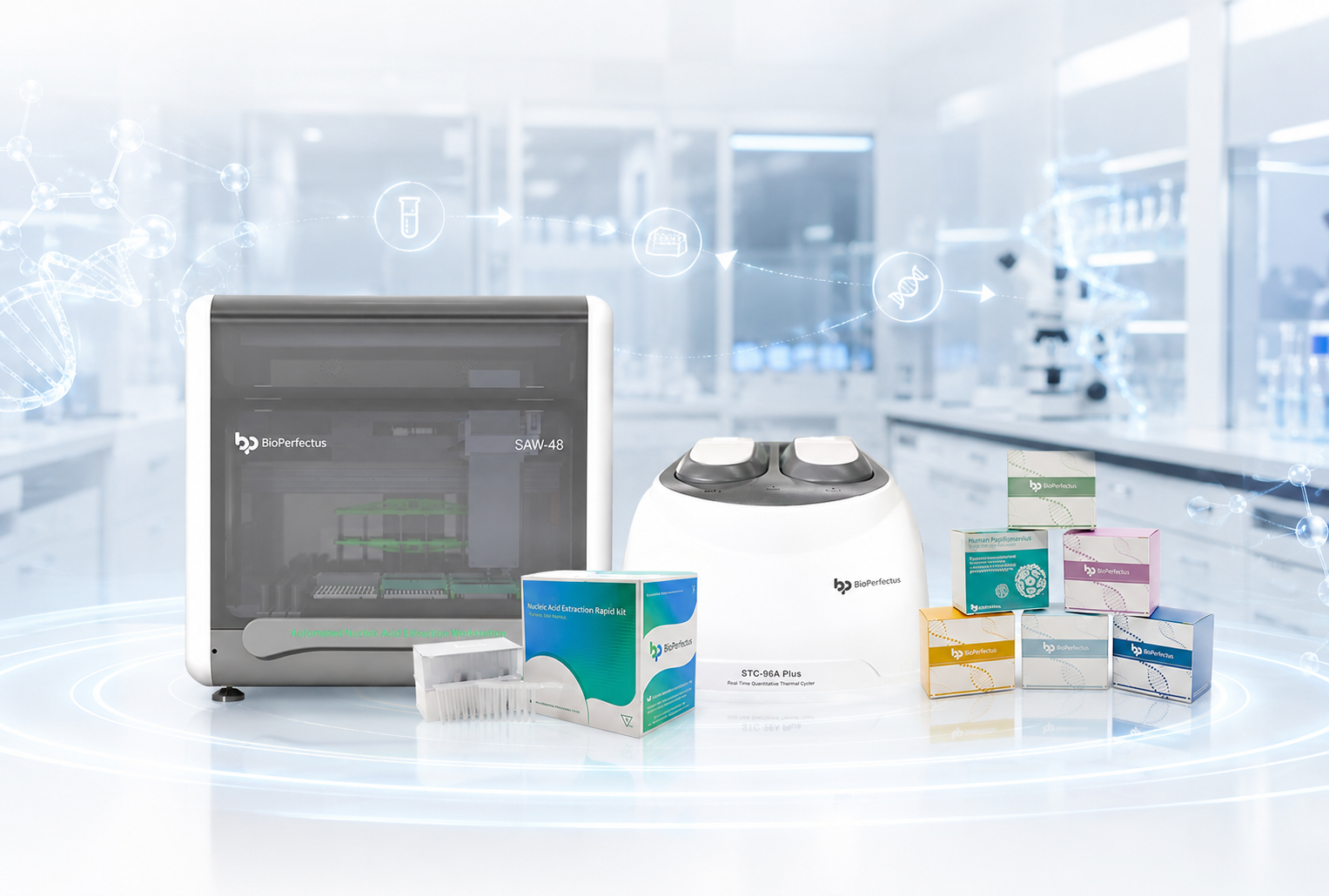
BioPerfectus Total PCR Solution
Instruments
Demand for molecular diagnostic instruments is increasing as hospitals and reference laboratories expand testing capacity in infectious disease surveillance, oncology, inherited disease screening, and precision medicine.
The main equipment trends identified include:
- Growing use of integrated systems that automate extraction, amplification, detection, and data analysis.
- High-throughput platforms combining automation, software integration, and quality management.
- Scalable systems for large healthcare networks managing higher testing volumes.
- Compact platforms for smaller laboratories and decentralized testing settings.
- Continued improvements in analytical sensitivity, workflow flexibility, and interoperability with laboratory information systems.
These trends indicate that equipment upgrades may involve different combinations of throughput, automation, integration, and laboratory size rather than one standard configuration.
Reagents and Consumables
Reagents and consumables are recurring components of molecular diagnostics. This category includes assay kits, enzymes, primers, probes, extraction reagents, controls, and quality-assurance materials. Demand generally increases with testing volume.
The main development areas include:
- More consistent reagent performance.
- Regulatory validation and compatibility with existing laboratory platforms.
- Reliable supply of essential testing materials.
- Standardized reagent formulations.
- Longer shelf life and simplified preparation.
- Continued development of multiplex assays.
For laboratories, reagent-related upgrades therefore focus on consistency, compatibility, supply continuity, and reduced operational complexity.
BioPerfectus provides molecular diagnostics solutions that align with evolving laboratory upgrade needs, including instrument optimization, compatible reagents, and workflow adaptation. Explore our molecular diagnostics products to identify a configuration that fits your laboratory requirements.
What These Trends Mean for Laboratory Planning
Taken together, these trends suggest that laboratory planning can begin with the existing workflow and service model. Laboratories may review bottlenecks from specimen receipt to result release, then consider whether integrated automation, scalable high-throughput equipment, or a compact system fits expected volumes, staffing, turnaround targets, and traceability needs.
Testing-menu planning can reflect current and anticipated assays, specimen types, validation resources, and regulatory requirements. Throughput estimates may also account for routine volume, seasonal peaks, urgent samples, and batch size.
In addition, evaluating instruments, reagents, and data systems together can help laboratories consider platform compatibility, reagent consistency, supply continuity, and workflow complexity when planning future molecular diagnostics capacity.
Conclusion
For 2026 and 2027, laboratory planning in molecular diagnostics is likely to focus on integration, scalable automation, menu flexibility, traceability, and recurring reagent requirements.
BioPerfectus supports these priorities with more than 700 diagnostic reagents and automated instruments across infectious disease testing and women’s and children’s health. By combining instruments with compatible reagents, our solutions can support standardized workflows from nucleic acid extraction and PCR setup to amplification and result interpretation. Different automation and throughput configurations can serve laboratories with different testing capacities.
Explore our molecular diagnostics products or contact our team to discuss your laboratory requirements.
References
[1] Fortune Business Insights. (2026, August 10). Molecular Diagnostics Market Size, Share, Trends and Industry Analysis, and Regional Forecast, 2026–2034.
[2] Global Market Insights. (2026, July). Molecular Diagnostics Equipment and Reagent Market Size & Share 2026-2035.
[3] Global Market Insights. (2025, November). China Molecular Diagnostics Market Size & Share 2025 - 2034.
